


Here's a question most agencies don't want you to ask: how much of your Google Ads revenue is actually coming from people who already know your brand?
Many agencies don't know how to acquire cold customers with Google, so they retarget the same people over and over again. In many accounts we audit, the answer is way higher than brands expect. And depending on how your campaigns are set up, that's either a sign your brand is healthy or a sign your entire account is built on a lie.
Branded campaigns are one of the most debated topics in Google Ads. Some marketers swear by them. Others say you're just paying for traffic you would have gotten for free. We manage millions in Google Ads spend every month for eCommerce brands, so here are the honest answers most agencies won't give you: what branded campaigns actually are, the argument for running them, and the bigger problem hiding behind the debate.
Prefer to watch instead of reading? Press play on the video below:
What Are Branded Campaigns in Google Ads?
A branded campaign is any Google Ads campaign that targets keywords containing your brand, your product name, or a close variation. For example, if you're ICON. Amsterdam and someone searches “ICON. Amsterdam” or “ICON. Amsterdam pants”, that's a branded search. If someone searches “protein powder” and your product happens to come up in Performance Max, that's non-branded, because they're not searching for your brand specifically.
The key distinction is search intent. With a branded search, the user is searching for you by name. They already have you in mind. With a non-branded search, they're searching for a category or a solution, and you're showing up as an option.
Google's campaigns will happily take your branded traffic and optimise for it. They optimise for conversions wherever they can find them, and they often take the easiest route. If your brand name is converting, Performance Max, Search and Shopping will all gladly bid on it. So the question is: should you actually run branded campaigns?
Why You Should Run Dedicated Branded Campaigns
Stop Overpaying for Clicks on Your Own Name
We see this in almost every account we audit: brands paying $2, $5, sometimes $10 per click on their own name inside Performance Max. When you set up a proper branded Search campaign with manual CPC bidding, that same click costs often around 30 to 40 cents.
Here is a real example: in one account, we selected all campaigns and all ad groups over 200 days, then filtered for the brand name. The average CPC was $73 for a keyword they should have paid far less for. Then we filtered for the branded campaigns we had set up, using the same branded keyword. The CPC was under a dollar. That is a massive markup you pay just because you haven't separated brand traffic. A dedicated branded campaign with controlled bids stops Google's automation from inflating your cost on traffic that would have converted anyway.
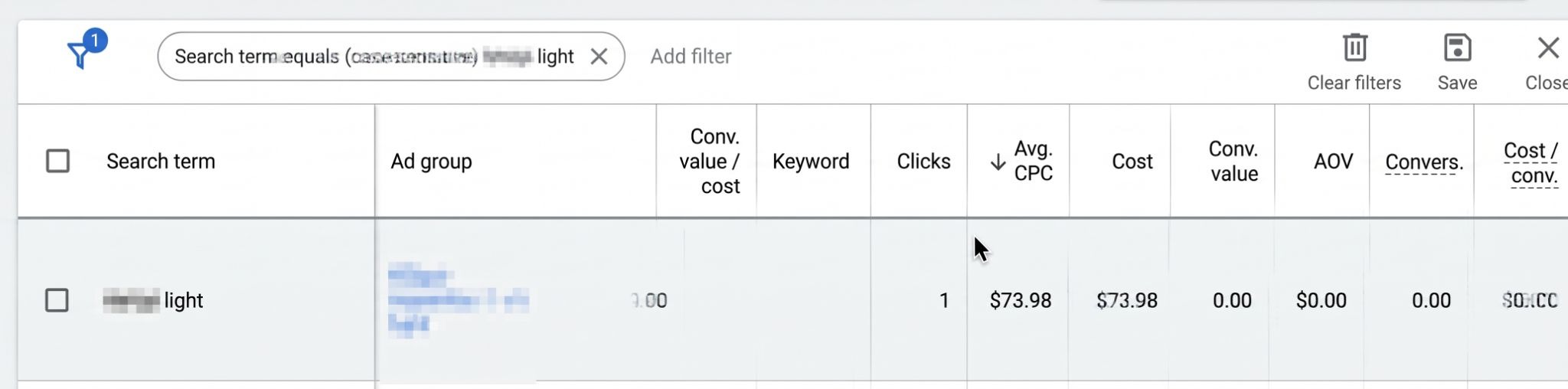
$73.98 average CPC across all campaigns
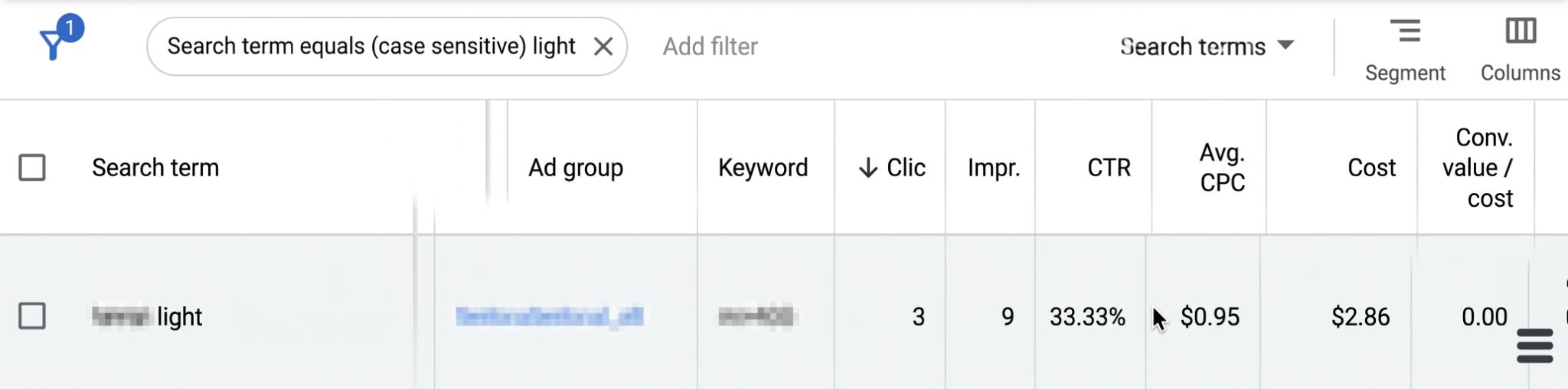
$0.95 average CPC in the dedicated branded campaign
Own the Shopping Carousel When Someone Searches Your Brand
This one is visual, and it matters more than most people think. When someone searches your brand name and sees a shopping carousel, who shows up? If you don't have a branded shopping campaign, the answer is most likely your competitors, or your Performance Max campaign showing a random selection of products at an inflated CPC.
A dedicated branded shopping campaign lets you control exactly which products appear, with optimised images and titles, so you can dominate that carousel with multiple listings. That might be different products, or strategic duplications of your best sellers. The goal is the same: own every slot when someone searches your name. If a customer searches for you by name and sees competitor listings before yours, that's a problem you can fix today.
The Real Problem: Branded Traffic Hiding in Prospecting Campaigns
Those are solid reasons to run branded campaigns, and we stand by all of them. But there's a different problem most brands don't realise they have. It's not about branded campaigns themselves. It's about branded traffic showing up in campaigns that are supposed to be finding you new customers.
Why Performance Max Bids on Your Brand by Default
When Performance Max runs without brand exclusions, which is the default, it can bid on your brand name. The reason is simple: branded traffic usually converts easily. The algorithm is optimising for conversions or conversion value, and people searching your brand name are the easiest conversions it can find.
So your Performance Max ROAS looks incredible. 8, 10, 12, sometimes even higher. Your agency shows you the report and everyone's happy.
How Branded Traffic Inflates Your Prospecting ROAS
Then you dig into the search terms and find that 50%, sometimes 75%, of those Performance Max conversions came from people who searched your brand name. They weren't prospecting for conversions.
In an account we audited, one of its best performing campaigns was marked as prospecting. When we filtered for one of the brand's terms and scrolled down, 6.4K of the campaign's 8.4K conversions were branded terms. They thought this was a prospecting campaign getting new customers.
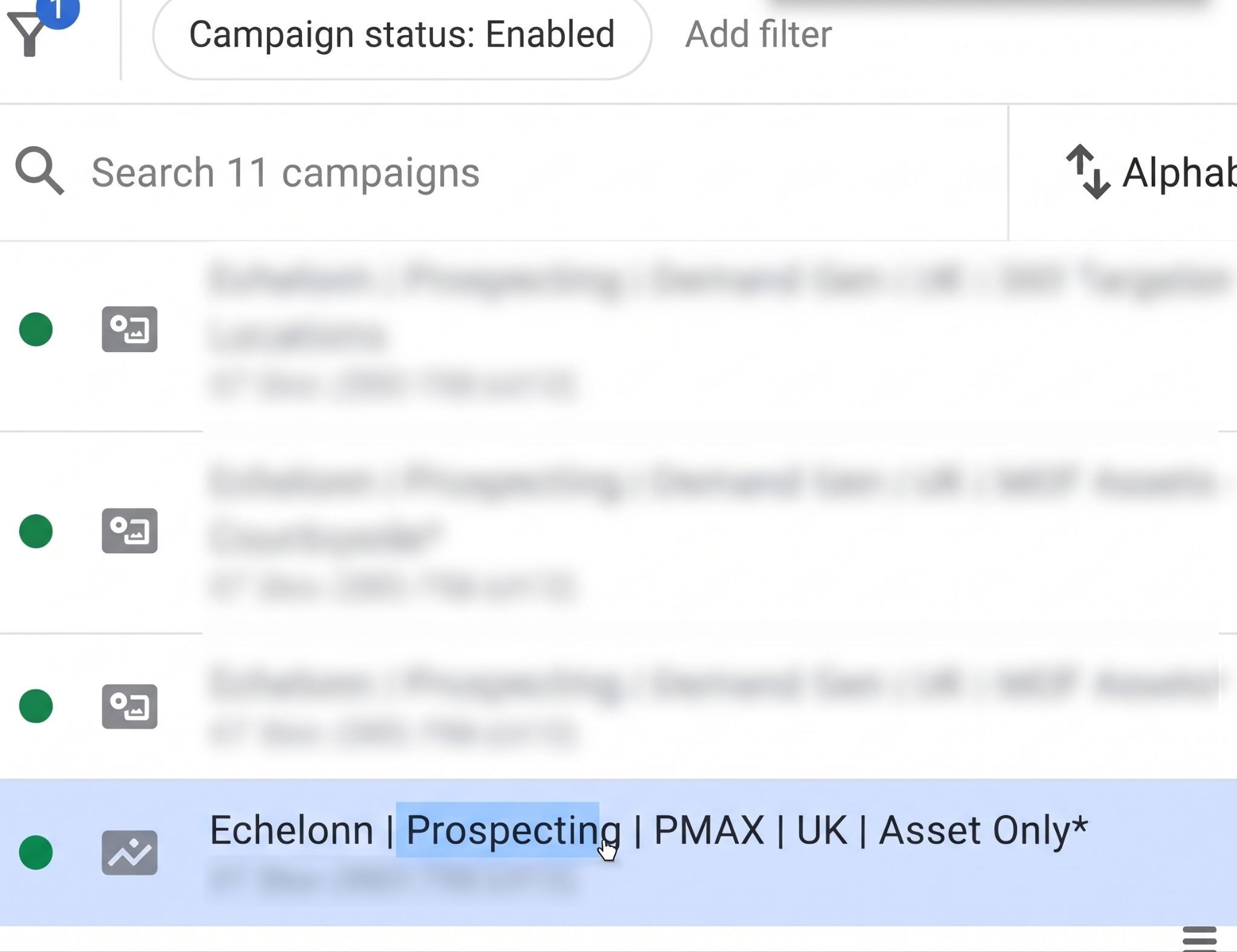
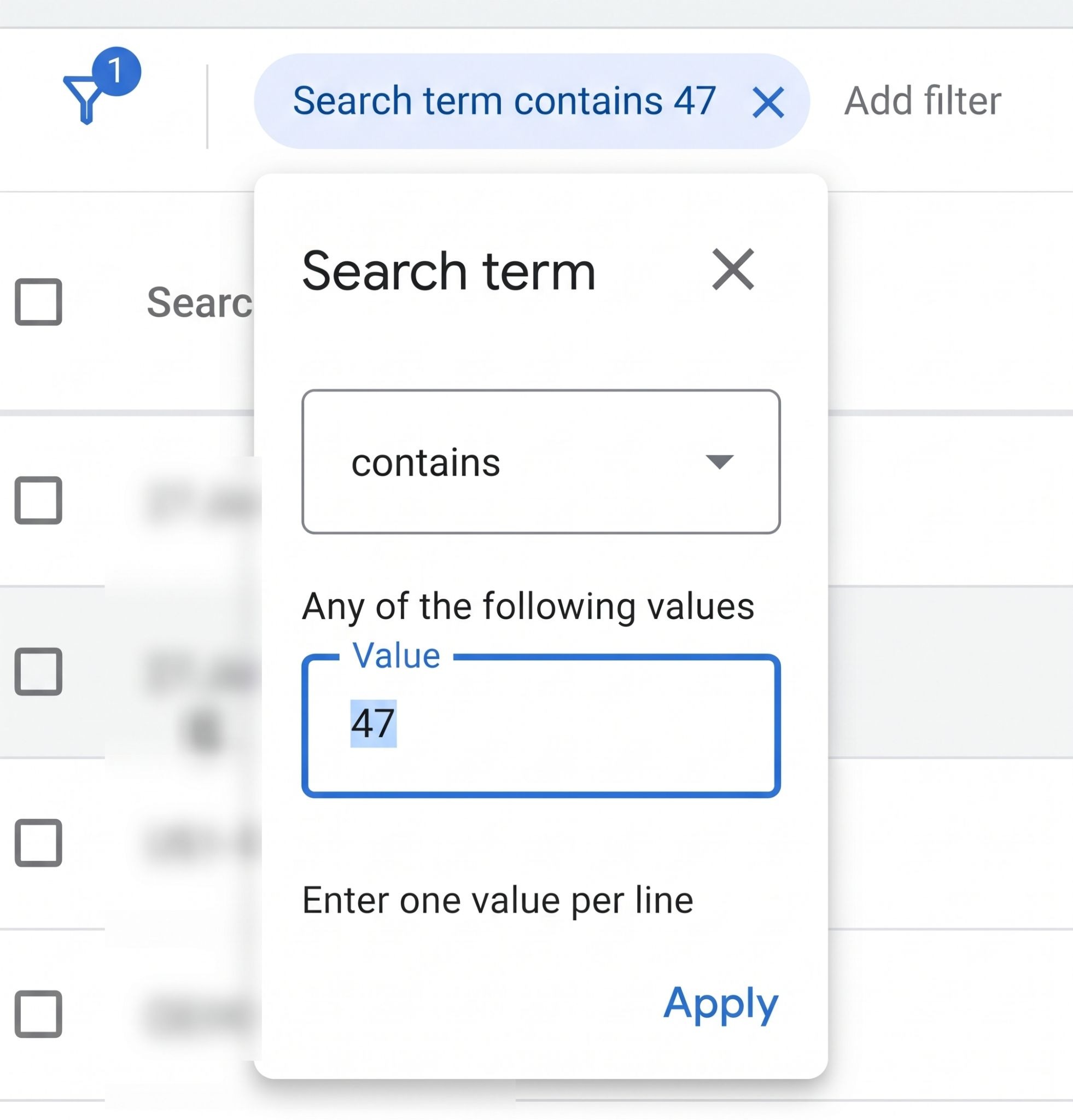
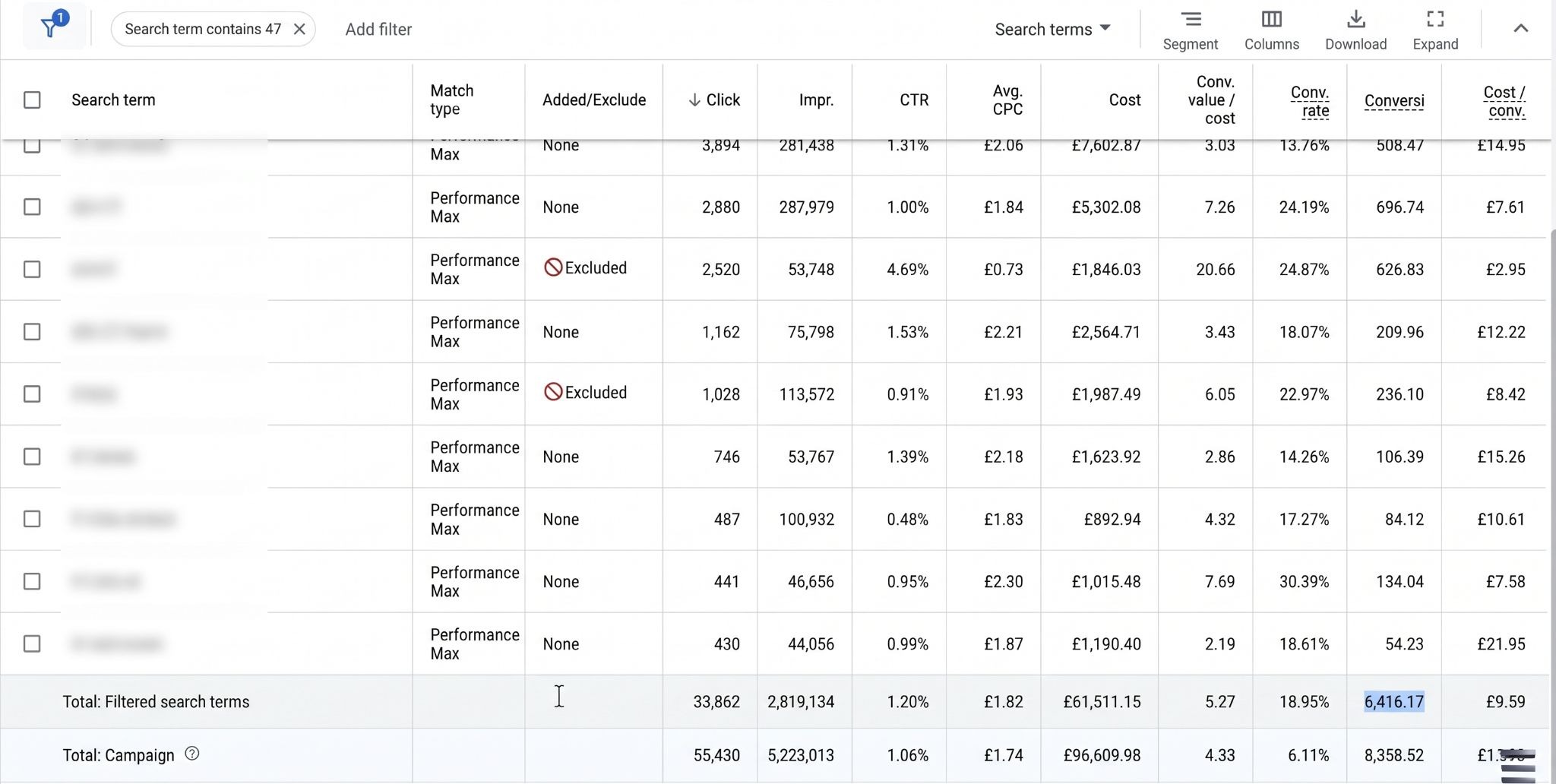
Search terms in a campaign marked as prospecting, filtered by one of the brand's terms. 6,416 of the campaign's 8,358 conversions came from branded searches.
This is where it gets dangerous for your growth. If Performance Max is quietly picking up branded conversions, your prospecting ROAS is inflated. You think you're acquiring customers profitably, and the numbers say everything's working. Then you properly separate brand traffic and your prospecting ROAS drops significantly.
That drop isn't a loss. It's the truth. Those prospecting numbers were never real, and the whole time you were making scaling decisions based on inflated data.
What Happens When You Separate Brand From Prospecting
We took over one account where branded campaigns were delivering around 80% of total account revenue. Everything was being propped up by branded traffic flowing through the wrong campaigns.
Once we separated brand and invested in real prospecting through feed duplication and different product angles, prospecting revenue jumped from 30K to 72–73K. Brand revenue stayed roughly flat at 65K. The account went from 80% brand dependent to nearly 60% prospecting driven. That is what healthy growth looks like.
But we couldn't even start building that until we could see what was actually prospecting and what was branded in disguise.
How Fixing Brand Structure Lifted ROAS by 215%
We have many examples like this; here's another brand we took over: On the surface the account looked great, with an overall ROAS of around 13.6. But branded traffic was mixed into Performance Max and there was no proper separation.
So we rebuilt the structure:
- Dedicated branded Search and Shopping campaigns, excluded from Performance Max
- A proper negative keyword list
- The brand Search campaign switched from Smart Bidding to a Target Impression Share strategy with controlled bids
Before the optimisation, this brand's branded campaigns were capturing only about 75% of their branded searches. They were losing a quarter of the people searching for their own name. By dropping CPCs by almost 70%, from around 27 cents to 9 cents, we could afford to show up on 95% of branded searches. The impact went beyond lower CPCs. Clicks doubled, revenue doubled, and ROAS improved by 215%, all while spending 36% less. We didn't create some new demand. We just stopped losing the demand that already existed.
What Changes in Your Prospecting Campaigns After the Fix
That's only half the story. The other half happens in the prospecting campaigns. In accounts where we've set these up, the prospecting campaigns used to get a lot of branded clicks. Ever since we fixed them, they have gotten none. They now only have prospecting traffic going through them.
Looking at the traffic for the brand new prospecting campaigns over the last 30 days, the average CPC stayed the same, even decreasing slightly over time, while the number of clicks went up tremendously. We stopped overpaying for brand traffic in the wrong campaigns and gave it a proper home. You get more traffic for the same budget, and the savings free up budget to reinvest into actual prospecting. Every dollar you save on brand traffic is a dollar you can put towards acquiring new customers.
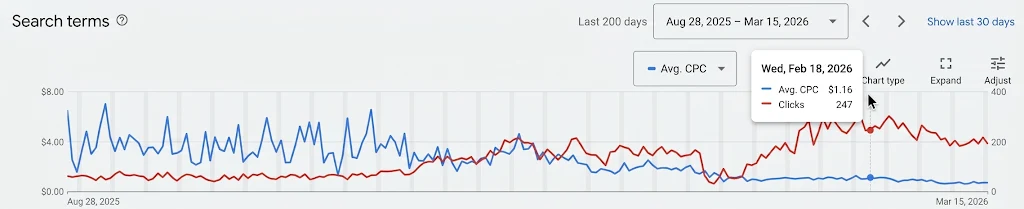
Average CPC (blue) and clicks (red) in the prospecting campaigns, 28 Aug 2025 – 15 Mar 2026. Once branded traffic had its own proper home, average CPC dropped and clicks climbed.
The Account Structure That Works at Every Budget
Here is the exact structure we recommend, based on what we call the four pillars of a high profit Google Ads account for eCommerce. The structure scales with your budget.
Under $5K per Month
Keep the structure lean, but still separate your branded traffic. You need:
- A branded Search campaign
- A branded Shopping campaign
- A prospecting Performance Max campaign with your brand excluded
At this budget you don't have enough data to split prospecting further. Trying to run five or six campaigns on $5K a month starves every campaign of the conversions it needs to optimise. But brand separation is non-negotiable at any spend level.
$5K–$15K per Month: Four Core Campaigns
This is where deeper separation becomes critical. You should have four core campaigns.
- Branded Search: Captures searches for your brand name, product names and close variations. Use exact or phrase match only, Manual CPC with a low bid cap, and a budget that is sufficient to cover existing demand, not create it.
- Branded Shopping: Captures branded product searches. Use a standard Shopping campaign set to really low priority, with Manual CPC and low bids or a high Target ROAS. Add a negative keywords script to make sure only branded queries trigger these ads.
- Non-Branded Search: Your prospecting engine on the Search side, built on category terms, problem terms and solution terms. Start with Manual CPC or Maximise Clicks, then move to Target ROAS once you hit around 50 conversions per month. Expect a lower ROAS than branded, but this is where real growth happens.
- Performance Max: Your main Shopping prospecting campaign. Brand must be excluded, so use brand exclusions at the campaign level and add negative keywords for your brand name variations. Start with Maximise Conversion Value.
Check your Performance Max insights often to make sure no branded queries or misspellings are leaking through.
You may also want a “wall” campaign. This is a standard Shopping campaign set to medium or high priority with a very low Manual CPC bid and your brand terms added as negative keywords. It competes with Performance Max for non-branded searches and catches the ones Performance Max misses, so they don't fall through to your branded Shopping campaign. Think of it as a safety net.
Over $15K per Month
You can start segmenting your prospecting campaigns further by product category or margin, but only if each campaign can still generate one to two conversions per day. As a rule of thumb, that's the threshold Smart Bidding needs to perform effectively. If you split too thin, you starve the campaigns again.
Let conversion volume decide the split, not budget. A product category or margin tier only earns its own campaign if it can still hit that one to two conversions per day. If it can't, keep it inside the larger campaign.
The segmentation applies to your prospecting side only. Brand separation stays non-negotiable at every spend level, so your branded Search and Shopping campaigns and the brand exclusions on Performance Max stay exactly as they are.
The budget you free up through clean brand separation is also what funds the next step: demand creation channels like YouTube.
What About YouTube and Demand Creation?
The ultimate goal of proper branded separation isn't just cleaner data and lower CPCs. It's freeing up budget and attention to invest in the channels that actually grow your brand. And the single most underutilised channel in Google Ads right now for eCommerce is YouTube.
Most brands look at their Search and Shopping campaigns, see they've captured most of the available demand, and think they've hit a ceiling. That ceiling only exists because you're only capturing demand. You're not creating it.
YouTube is the second largest search engine in the world, and one of the best platforms for building brand awareness at scale. But here's what most eCommerce brands get wrong. They look at their YouTube ROAS in Google Ads, see 1.5x, decide it's not working and cut the budget straight away. The problem is that YouTube doesn't work like Search or Shopping. People see your ad on YouTube and they don't buy straight away. YouTube creates the demand that your other campaigns, on Google or Meta, then capture. It's a touchpoint at the top. You can still get conversions from YouTube, but most of the time it's an awareness player.
When you tap into YouTube the way it's supposed to be used, it's basically another Meta. You're not capped by search volume or existing demand, and you can reach new audiences. You can ultimately scale it harder than Meta, because YouTube has a larger overall audience pool.
How to Check Whether Branded Traffic Is Leaking Into Your Prospecting
Start with the search terms report in your prospecting campaigns, filter for your brand terms, and look at how many conversions they account for. If your “prospecting” campaign shows branded terms driving a large share of its conversions, you have a leak.
To stop Performance Max from picking up your brand, there are three things to do:
- Apply brand exclusions at the campaign level. Brand exclusions are not on by default.
- Add negative keywords for your brand name variations.
- Check your Performance Max insights often for branded queries or misspellings leaking through.
Once the separation is in place, track the ratio of branded to non-branded revenue. If brand is still the majority of your account after two months, you need to reconsider who is managing your account.
The Bottom Line: Branded Traffic Needs Its Own Home
Dedicated branded campaigns keep your click costs down and your results under your control. The real damage starts when branded traffic flows through Performance Max and your other prospecting campaigns, because it props up your ROAS and hides how much of your revenue really comes from new customers.
Give branded traffic a proper home and exclude your brand from Performance Max, and your prospecting numbers become something you can trust. From there you can scale with confidence, and put the budget you've saved into channels like YouTube that create demand instead of only capturing it.