
.svg)
YouTube Ads Targeting Framework That's Driven $10M+ for eCommerce Brands


Most brands still think YouTube Ads for eCommerce don’t work. Usually, that’s because they’re trying to run YouTube the same way they run Meta ads. But it’s a different platform with different user behaviour and a very different algorithm.
We’ve used the YouTube Ads targeting framework below to help generate more than $10M for eCom brands across multiple industries, including supplements, beauty, fashion, and skincare. And in a lot of cases, YouTube started driving direct sales and also lifting performance across Google Shopping, branded search, Meta, and even Amazon.
With Google continuing to push Demand Gen as the future of YouTube advertising, understanding how to structure campaigns and feed the algorithm properly matters more than ever. In this article, we’ll break down the exact YouTube Ads targeting framework we use, including campaign structure, audience layering, YouTube Shorts strategy, KPI benchmarks, and the scaling protocols behind campaigns spending well beyond $20k/month.
Watch the full YouTube Ads targeting framework breakdown:
Why Most YouTube Ads for eCommerce Fail
Most eCommerce brands fail with YouTube Ads because they try to run YouTube the same way they run Meta ads. They launch broad campaigns, let Google automate everything, and expect instant direct-response performance.
But YouTube works differently. We call the YouTube algorithm a “lazy beast”. It’s incredibly powerful, but it relies heavily on behavioural signals like search activity, content engagement, and watch patterns. If you don’t feed it the right data, it starts spending budget on low-quality traffic very quickly.
A lot of brands also misjudge YouTube performance because they only look at in-platform ROAS. We’ve seen campaigns showing a 1.5x ROAS inside Google Ads while total blended ROAS across Shopify and Amazon sat above 5x once attribution was cleaned up properly.
The problem usually comes down to a messy structure. Mixing prospecting, remarketing, and different video formats into a single campaign causes confusion and weakens performance. To scale, you need a framework that separates your funnel stages and uses specific creative formats for specific audiences.
The Campaign Structure We Use for YouTube Ads Targeting
Separate Prospecting and Remarketing Campaigns
We separate YouTube campaigns into two core objectives: prospecting and remarketing. This separation is crucial because it gives us complete clarity over each funnel stage while stopping Google from blending prospecting and remarketing signals together.
Prospecting campaigns focus on acquiring new customers, while remarketing campaigns focus on users who already know the brand through website visits, video engagement, or previous purchases. Keeping these separated stops Google from prioritising easy retargeting conversions over genuine new customer acquisition.
Split Ad Groups by Format
We also split ad groups by format wherever possible, especially across YouTube Shorts, in-stream ads, and in-feed placements.
Each format behaves differently and requires different creative approaches. Shorts users consume content very differently from someone watching long-form YouTube videos, so running the same creatives across every placement usually weakens performance. By splitting formats, you can tailor creatives to each environment and control exactly how budget is distributed as campaigns scale.
The 3-Tier YouTube Ads Targeting Framework
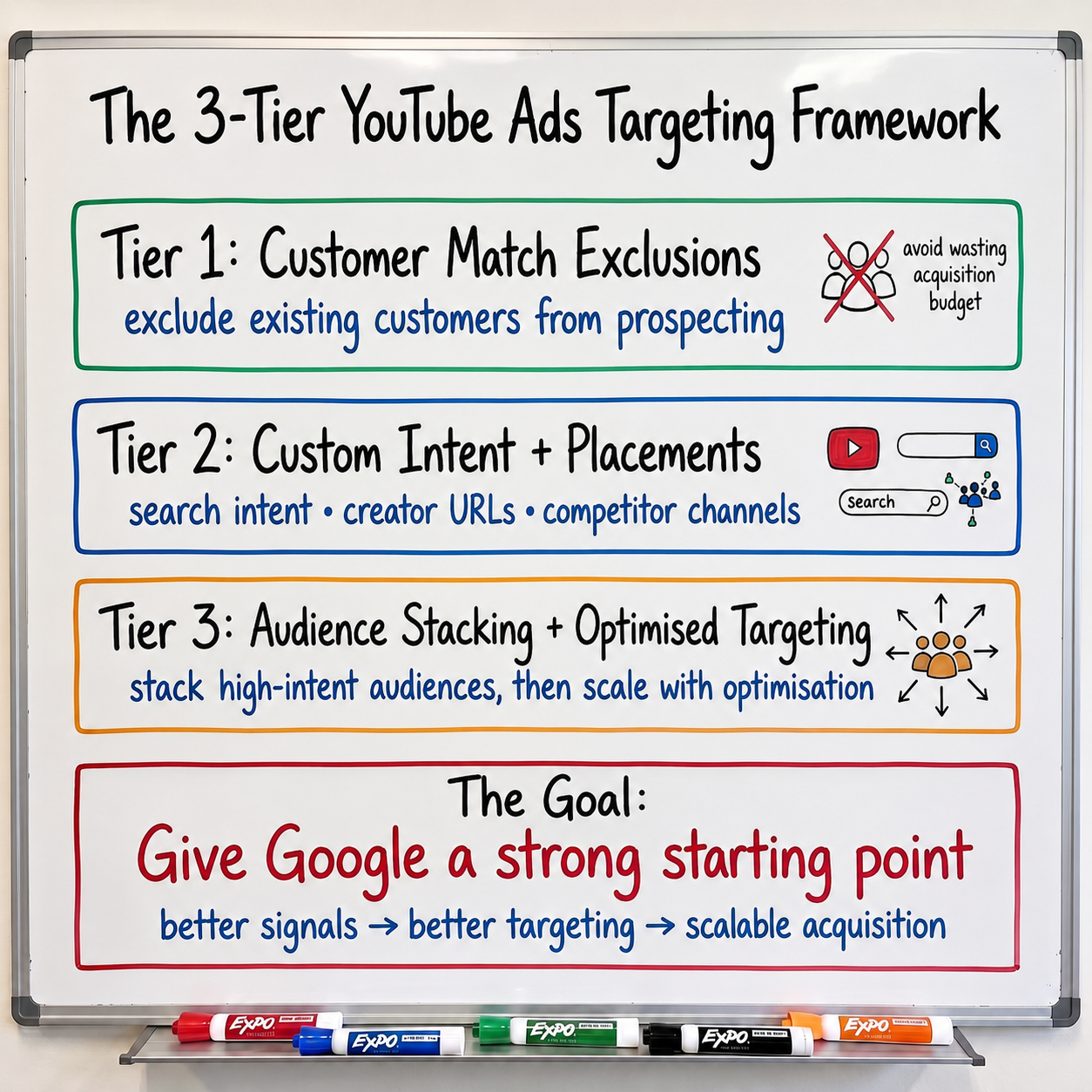
Once the campaign structure is in place, the next step is feeding Google the right audience signals. But many brands either go too broad too early or stack random audiences together without giving the algorithm clear direction. The framework below is the structure we use across most eCommerce YouTube campaigns.
Tier 1: Customer Match Exclusions
Your existing customer list is one of the most valuable targeting assets inside Google Ads. But for prospecting campaigns, we mainly use it for exclusions.
The goal is simple: stop wasting budget by showing acquisition ads to people who already purchased from you. We typically build exclusion windows across 30-day, 90-day, 180-day, and 365-day purchasers. This keeps prospecting campaigns focused on genuine new customer acquisition instead of paying premium CPMs to retarget people who likely would have bought again anyway.
Tier 2: Custom Intent and Placement Targeting
This is where YouTube starts getting powerful. Custom intent audiences allow you to target users based on their search history and video consumption patterns.
For example, if you’re selling supplements, you can build audiences around searches like “best protein powder reviews” or “creatine before and after.” You can also inform Google's algorithm by including competitor channel URLs or niche-specific creator URLs in your custom segments. The goal is to help Google better understand the type of user most likely to convert.
Tier 3: Optimised Targeting and Audience Stacking
This is where a lot of accounts make critical mistakes. Brands often combine broad demographics with highly specific audiences, which usually causes the broader audience to overpower everything else.
Instead, we stack two to three highly relevant audience signals together, like best custom intent audiences, specific in-market segments, or lookalike audiences. From there, we enable optimised targeting. This gives Google a strong starting point while still allowing the algorithm to scale beyond the initial audience pool.
Best YouTube Ad Formats for eCommerce Brands
In-Stream Ads (40-50% of Budget)
In-stream ads usually take up the biggest share of budget for us, often around 40-50% of total spend. They work best for detailed value propositions because someone who chooses to watch past the first 5 seconds is showing high purchase intent. The biggest factor here is the hook. If the opening doesn’t capture attention immediately, performance drops fast. The best-performing creatives usually focus on entertainment, education, problem awareness, or strong brand positioning before transitioning into the offer.
Non-Skippable Ads (20-30% of Budget)
Non-skippable ads usually work better for brand awareness than aggressive direct response, which is why we often allocate around 20-30% of ad spend here. We commonly use them before major sale periods like Black Friday, Cyber Monday, Christmas, or product launches where brand recall matters more than immediate conversions. Lifestyle-focused creatives and repeated exposure tend to perform best here.
YouTube Shorts Ads (20-25% of Budget)
This is your biggest opportunity. But here’s the catch: anything that looks like a polished ad will usually fail. The most successful Shorts campaigns use "ugly" User-Generated Content (UGC). When people are scrolling through Shorts, they are in consumption mode, not "buy now" mode. Authentic, raw content has a much better chance of stopping the scroll than a high-production commercial.
"Quick rule of thumb:
In-stream is for education and purchase intent.
Non-skippable is for brand recall.
Shorts is for attention and reach.
Trying to force the same creative across all three usually weakens performance.”
YouTube Ads KPI Benchmarks That Actually Matter
YouTube calculates KPIs differently from platforms like Meta and Search, which is why a lot of brands misread the data early on. If you evaluate YouTube through a traditional direct-response lens, a lot of the metrics can look misleading at first. Here are the benchmarks we look for in our accounts:
View Rates
View rate is one of the fastest ways to tell whether your creative and audience targeting actually match. In our accounts, we typically see view rates ranging from 15% to 35% depending on creative quality and audience targeting. For YouTube Shorts, we usually aim for view rates above 8-10%. For in-stream ads, we generally want to see 20%+.
Keep in mind how Google defines a "view": it’s 10 seconds of watch time for Shorts and 30 seconds for in-stream. Low view rates usually point to weak hooks or creatives that feel too much like traditional ads. Over time, that often leads to higher CPMs and weaker overall performance.
CTR Benchmarks
In our successful YouTube campaigns, CTR usually ranges between 0.5% and 1.2% depending on format and targeting. As a general benchmark, we typically want to see at least 0.75%+.
If CTR is low, the issue is often the offer, call-to-action, or how clearly the value proposition is communicated inside the creative. If your CTR is above the benchmark, but sales are low, focus on conversion rate optimisation on your landing page and checkout experience.
CPM Benchmarks by Industry
CPMs vary heavily depending on industry, competition, targeting, and ad format. Generally, Google charges more for formats that disturb the user experience (like non-skippable ads). As a rough benchmark:
- supplements often sit around $8-18 CPMs,
- fashion and apparel around $6-12,
- while tech and software can push anywhere from $12-25.
Across formats, in-stream campaigns commonly land around $13-15 CPMs, while Shorts are often cheaper at roughly $6-8. If CPMs start rising too aggressively, it’s often a sign that your targeting is too narrow or competition inside the auction is increasing.
How We Scale YouTube Ads Without Killing Performance
Scaling YouTube Ads is very different from scaling Search or Shopping campaigns. Push budgets too aggressively before the algorithm has enough data, and performance usually becomes unstable very quickly. Over time, we’ve found that YouTube rewards consistency far more than aggressive scaling.
Here’s the scaling protocol we use for clients spending over $20k/month.
Phase 1: Data Collection
For new campaigns, we typically start with Maximise Conversions for the first two weeks. YouTube needs more conversion data than most brands expect because conversion cycles are usually longer and user behaviour is less direct than Search traffic.
In most cases, we recommend starting with enough budget ($100-200 depending on your Target CPA) to consistently generate meaningful conversion data rather than underfunding campaigns too early.
Phase 2: Switch to Target CPA
After gathering 50+ conversions, we usually transition into Target CPA bidding.
At this stage, volatility is normal – expect anywhere between 20% to 30% more volatility than Search campaigns. YouTube campaigns often fluctuate more than Search campaigns because users rarely convert immediately after seeing an ad. The goal here is giving the algorithm enough time to stabilise and find profitable acquisition costs.
Phase 3: Scaling Discipline
This is where most brands destroy their own success. They see campaigns working, double budgets overnight, and completely reset optimisation stability.
We typically scale YouTube budgets gradually, around 20% increases every 3 to 5 days rather than massive jumps all at once. The bigger the budget increase, the more Google has to test new auctions and broader traffic pools, which is why aggressive scaling often hurts efficiency. In most cases, consistency performs far better than panic-budgeting.
Final Takeaway: Building a Scalable Acquisition Engine
YouTube rewards strong audience signals, clean campaign segmentation, format-specific creatives, and patience during optimisation. When those pieces are in place, the platform becomes far more than just another acquisition channel. It becomes a sustainable acquisition engine that drives direct conversions, supports branded search and Shopping performance, and improves overall channel performance beyond what’s shown inside the ad platform alone.
And with Google continuing to push Demand Gen deeper into YouTube advertising, understanding how YouTube Ads targeting actually works is only becoming more important for eCommerce brands. Knowing these strategies is one thing, but executing them profitably is where most brands struggle. The brands that win aren’t those with the biggest budgets, but those with the discipline to feed the algorithm correctly and the patience to let their campaigns scale.

Ready To Start Scaling Today?
Scaling Your Favorite eCommerce Brands To The Highest Levels Through Google & YouTube Ads.

.svg)
Get Smarter About How To Scale Your Brand...
Discover Insider Knowledge On How We Scale Brands From 7 Figures All The Way Up To 8-9 Figures With Google Ads.
.svg)
.svg)
"The best Google ads agency there is. You only need to look at the quality of clients and the reviews to understand Jackson and his team are the real deal."

"One of the best in the agency space, great service and exceptional results. Since signing on with Jackson he has become one of our greatest assets when scaling."

"Top tier team & service delivery. Jackson is relentless when it comes to fulfilment & client needs. His attention to detail during the onboarding process ensured exponential results for my coaching business. If you're looking to elevate your ad results & learn a tone of new options/skills that can be implemented to drive more sales to your business then I'd strongly recommend Echelonn."

"From the very first conversation with Jackson and his team, it was clear that we had found a Google Ads agency that prioritises results above all else. Their collaboration between data-driven experts and a skilled copywriter creates a dynamic duo for Google advertising success..."

"Been working with them for 9 months and it's been a great experience. Jackson and his team know what they are doing and always goes above and beyond. If you're looking for a reliable Google ads agency this is the one."

"The best Google ads agency there is. You only need to look at the quality of clients and the reviews to understand Jackson and his team are the real deal."
"One of the best in the agency space, great service and exceptional results. Since signing on with Jackson he has become one of our greatest assets when scaling."
"Top tier team & service delivery. Jackson is relentless when it comes to fulfilment & client needs. His attention to detail during the onboarding process ensured exponential results for my coaching business. If you're looking to elevate your ad results & learn a tone of new options/skills that can be implemented to drive more sales to your business then I'd strongly recommend Echelonn."
"From the very first conversation with Jackson and his team, it was clear that we had found a Google Ads agency that prioritises results above all else. Their collaboration between data-driven experts and a skilled copywriter creates a dynamic duo for Google advertising success..."
"Been working with them for 9 months and it's been a great experience. Jackson and his team know what they are doing and always goes above and beyond. If you're looking for a reliable Google ads agency this is the one."
More Articles Like This.
Find answers to common queries about our services and how we can help you.
.svg)
Google Ads Optimization Score: Should You Trust It?
What Is a Good CTR for Google Ads?
Why More Google Ads Spend Doesn't Always Mean More Revenue
How To Rank Your Google Shopping Ads Multiple Times
Why Your Google Ads Scale Breaks After $X Per Day
How to Tell if Your Google Ads Agency Is Underperforming
Why Your Performance Max Campaign Gets Clicks but No Sales
.png)
Why Your Google Ads Budget Isn't Spending (And How to Fix It)

The Right Way to Run Google Dynamic Search Ads
How to Get New Customers With Google Ads in 2026
Why Your Google Ads CPA Keeps Increasing and How to Reduce It
What Is a Good ROAS for eCommerce Businesses?
How to Set Up Google Ads Conversion Tracking the Right Way
How Much Does a Google Ads Agency Cost?
Why Your Google Ads Are Not Converting
.png)
Average CPC in Google Ads by Industry (And What It Means for Your Strategy)
Performance Max vs. Shopping Campaigns: Which One is Better?

Why Your Google Shopping Ads Get Impressions But No Clicks (Image Optimization Guide)
Why Your Google Ads Are Not Showing

YouTube Ads Targeting Framework That's Driven $10M+ for eCommerce Brands

What Professional Google Shopping Ads Management Looks Like
How Much Do Google Ads Cost in 2026?

Should Your Business Use Google Search Ads or Performance Max?

Performance Max Best Practices for Sustainable Growth
.png)
Google Shopping Ads Audience Targeting: What Actually Impacts Performance
.png)
How to Write Google Search Ads That Actually Convert
.png)
6 Google Shopping Feed Best Practices That Drive Better ROAS
%20(1).png)
How to Get Your Products Recommended by AI (ChatGPT, Google AI & More)
.png)
Common Google Ads Myths That Cost Businesses Money
.png)
7 Benefits of Google Shopping Ads for Your eCommerce Business
.png)
How to Switch Google Ads Agency Without Losing Performance or Data
.png)
Demand Capture vs Demand Generation: Where Google Ads Fits
.png)
How to Prepare Your Business for Working With a Google Ads Agency

How to Avoid Wasting Budget on the Wrong Searches With Google Ads Keyword Match Types
Google Ads Account Ownership: What Businesses Should Know Before Hiring an Agency
.png)
Landing Page Optimization Strategies That Increase Conversions
SEO and Google Ads: How Search Engine Optimization and Paid Search Work Together
Types of Remarketing in Google Ads: How Each One Works and When to Use It
Google Ads Keyword Research: How to Find Keywords That Actually Convert
.png)
What Is Google Performance Max and How Does It Work?
.png)
How Advertorials Support High-Intent Google Ads Funnels
%20(Canva%20Template).png)
How Audience Targeting Works in Google Search Ads (and When to Use It)

Google Ads for New Brands: What to Know Before Spending Your First Dollar
.png)
What Is a PPC Agency – and When It Makes Sense to Hire One
%20(3).png)
eCom Growth Strategy: How We Scaled a Supplement Brand From $1.9M to $8.6M With Google Ads

%20(4).png)
Google Merchant Center Fix: How to Improve Rankings With Accurate Shipping Times

CTR Is Misunderstood by 95% of the PPC Industry (What to Optimise for Instead)

Complete YouTube Ads Guide 2025 | 3 Formats, 5 Principles, Proven Results
%20(2).png)
eCom Growth Strategy With Google Ads in 2025
%20(1).png)
YouTube Advertising Strategy: How to Drive Results Across Every Format

YouTube Ads Analytics 101: Key Metrics and How to Use Them

YouTube Ads Cost in 2025: How to Launch & Optimize a YouTube Advertising Campaign