
.svg)
How Audience Targeting Works in Google Search Ads (and When to Use It)


%20(Canva%20Template).png)
Audience targeting in Google Search Ads is often misunderstood. Many advertisers assume it works the same way as audience targeting in Display or YouTube ads, or they expect it to replace keyword targeting altogether.
Google Search Ads is a campaign type within Google Ads. While audiences play a major role in some campaign types, Search campaigns are fundamentally driven by keyword intent. Simply put, in Search Ads, the keywords determine whether your ads are shown – not audiences.
But audiences still matter – they influence how your ads are shown, who gets priority in auctions, and how aggressively you bid for certain users. This guide explains how audience targeting works in Google Search Ads, when it improves performance, and when it’s better to not use it.
What Is Audience Targeting in Google Search Ads?
Audience targeting in Google Search Ads allows advertisers to adjust how their ads are shown based on who the user is in addition to what they are searching for. Rather than acting as rigid targets, audiences in Search function primarily as signals that help Google better interpret user intent and value. This differs from social advertising, where you can select specific demographics to see your ad. It adds an extra layer of context and helps Google understand which users are more valuable to your business. Thanks to this information, you can then prioritize those users through bidding, audience-based messaging logic, and performance analysis.
In practice, audience targeting in Search Ads is commonly used to analyze performance across different user groups, apply bid adjustments or Smart Bidding signals, and prioritize high-value users without limiting overall reach. Advertisers typically provide audience lists, such as past purchasers or website visitors, to help the platform better understand which users are more likely to convert. However, If there is no keyword match in Search Ads, the ad will not show, regardless of audience – and that is a major difference to other campaign types.
When used correctly, audience targeting in Search improves efficiency and insight. But when it’s not used right, it can restrict reach, learning, and reduce performance.
How Audience Targeting Works in Search Ads
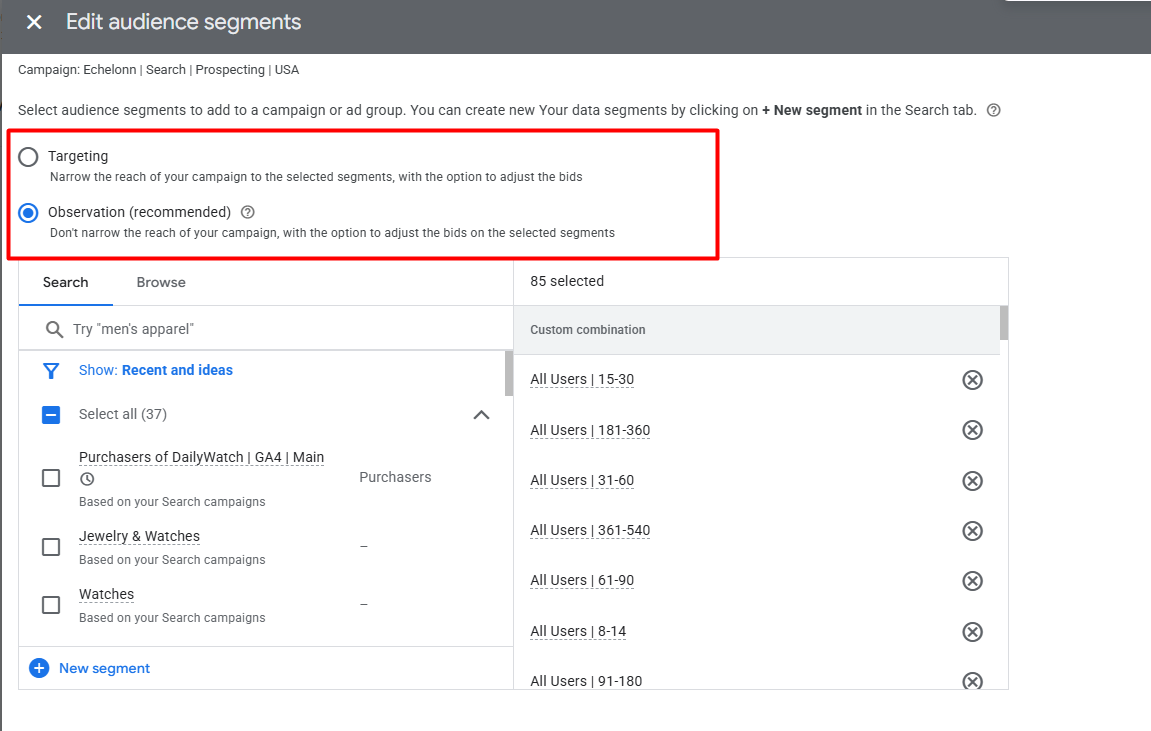
When adding audiences to Search campaigns, advertisers have to choose between Observation and Targeting. This choice affects reach, performance, and how much data Google can collect for optimization.
Observation Mode
Observation allows you to add audiences to a Search campaign without restricting who can see the ads. They are still shown to anyone who searches for the targeted keywords, but Google also collects data across different audience segments.
This mode is primarily used to collect and analyze data before making any restrictive decisions. You can use Observation mode to identify the audiences that convert better, apply bid adjustments, and use the data to inform long-term bidding and optimization strategies.
For most Search campaigns, Observation is the recommended default. It provides valuable insights without limiting reach. While gaining data, you’re not preventing ads from showing to all relevant users searching for your keywords.
Targeting Mode
Targeting restricts ads to only users who belong to selected audiences. If a user searches for a keyword but doesn’t match the audience criteria, the ad will not show. That’s the reason why it’s recommended to approach Targeting carefully.
It’s suited in very specific situations, such as remarketing-only search campaigns, campaigns designed exclusively for past visitors or customers, and highly controlled experiments with sufficient data available. For prospecting or general non-branded Search Campaigns, Targeting often leads to missed demand and slower learning. Because of this, it’s generally advised not to build Search campaigns based solely on audience segments.
In most cases, Search campaigns perform better when they are structured around business logic, such as product categories, services, or priorities, while audiences are used in Observation mode as signals. This approach allows Google’s algorithm to learn across all relevant search demand, optimize bidding more efficiently, and prioritize higher-value users without excluding others.
Targeting works best when the goal is intentional restriction. Observation is usually the better choice, because it captures all relevant search demand, lets Google’s algorithm learn faster, and allows optimizing bids and prioritization based on real data.
“Common audience types used in Search include remarketing lists, Customer Match, in-market audiences, and detailed demographics. While these audiences are available across Google Ads, their role in Search campaigns is different and primarily focused on bidding, prioritization, and analysis." Source: Google Ads Help – About audience segments
When Audience Targeting Helps Search Campaign Performance
Audience targeting in Google Search Ads works best when it supports existing intent rather than trying to create it. Below are some of the most common situations where audience targeting tends to make a measurable difference in Search campaign performance.
Branded Campaigns
Users searching for a brand name already demonstrate the highest level of intent. In branded Search campaigns, the primary objective is usually to capture this demand efficiently rather than to create additional intent. Branded searches typically convert well with relatively low competition, which means aggressive bid increases are often unnecessary.
In practice, branded campaign performance is more strongly influenced by keyword strategy and traffic control than by audience-based bid adjustments. Using exact or phrase match keywords helps ensure that branded traffic is captured without overspending, while audiences can remain a supporting signal rather than the main optimization lever.
When used this way, audience targeting complements branded campaigns without inflating costs and helps maintain efficiency in competitive markets.
High-Intent Non-Branded Keywords
For non-branded keywords with clear purchase intent, audience targeting helps allocate budget more effectively. Instead of raising bids across the board, advertisers can focus on users more likely to convert.
This is particularly useful for competitive keywords with high CPCs (Cost Per Click), limited budgets that need to be prioritized, and accounts aiming to improve CPA (Cost Per Action) or ROAS (Return on Advertising Spend) without reducing reach. Using audience signals in Search campaigns helps advertisers stay aggressive where it matters the most without burning spend on lower-value clicks.
Longer Sales Cycles
Businesses with longer decision-making processes often see better results when audience targeting is layered into Search campaigns. Users rarely convert on their first interaction in these cases. Audience targeting allows advertisers to recognize users who have previously engaged, adjust bids based on funnel stage, and support repeat searches throughout the consideration phase.
This way, Search campaigns better align with real buying journeys. It’s particularly effective for B2B, high-consideration products, and services where multiple touchpoints are required before making a decision to convert.
Data-Driven Optimization and Insights
Audience targeting plays an important role in understanding what drives performance in Search campaigns. By analyzing results across audience segments, advertisers can identify users who convert more efficiently, and adjust bidding, prioritization, and overall strategy accordingly. Data helps spot wasted spend across segments and supports more informed decisions around bidding, landing page strategy, and messaging.
While these insights are very important for Search campaigns, they can also often help shape an overall marketing strategy. Even when data doesn’t always improve performance immediately, the insights remain highly valuable.
When Audience Targeting Can Hurt Performance
Audience targeting can be a helpful tool that improves efficiency, but it can also hurt performance when applied without enough data, context, or intent alignment. Using audiences in Search Ads too aggressively or too early is usually the problem. Below are some of the most common scenarios where audience targeting becomes a limitation rather than help.
Low-Volume or New Accounts
Search campaigns need sufficient data to learn which users convert and why. When audiences are layered too early, especially in Targeting mode, they can significantly reduce reach and slow down the learning process. On top of that, they can create misleading performance signals.
New Google Ads accounts or campaigns should start in Observation mode and allow Google to learn and gather data. Audience insights can come later, once the campaign has enough data to support optimization.
Over-Segmentation and Too Many Audiences
Adding too many audiences to a Search campaign can quickly make performance harder to interpret and optimize. Segmentation can feel like better control, but in reality it actually provides diluted data across multiple audience layers and unclear optimization signals. Especially for small or mid-sized accounts, it brings unnecessary complexity.
In Search Ads, simplicity often outperforms over-engineered setup. A smaller number of audience signals usually provides clearer insights compared to dozens of overlapping segments.
Expecting Audiences to Fix Poor Keyword Strategy
If the advertiser’s fundamentals are weak, audience targeting can’t compensate for them. Keywords need to reflect real user intent and campaigns can’t rely on overly broad or irrelevant search terms. The same applies to unclear offers, weak landing pages, and missing or inaccurate conversion tracking.
Keyword intent is essential in Google Ads – and in Search Ads it remains the primary performance driver. Audiences work best when the foundations are already strong, rather than when they mask problems.
“In Google Search Ads, audiences don’t replace keyword intent. They work best when strong fundamentals are already in place.”
Key Takeaways: How to Use Audience Targeting in Search Ads Strategically
Audience targeting in Google Search Ads is about prioritizing and efficiency. It shouldn’t be used as a tool for narrowing reach or controlling who sees your ads, but rather to help you make better and more informed decisions.
Search campaigns rely on keyword intent first. Audiences add context to help Google and advertisers understand which users are valuable and how aggressively to compete for them – especially when paired with Smart Bidding strategies that rely on accurate signals. When this balance is respected, audience targeting can improve performance without limiting growth.

Ready To Start Scaling Today?
Scaling Your Favorite eCommerce Brands To The Highest Levels Through Google & YouTube Ads.

.svg)
Get Smarter About How To Scale Your Brand...
Discover Insider Knowledge On How We Scale Brands From 7 Figures All The Way Up To 8-9 Figures With Google Ads.
.svg)
.svg)
"The best Google ads agency there is. You only need to look at the quality of clients and the reviews to understand Jackson and his team are the real deal."

"One of the best in the agency space, great service and exceptional results. Since signing on with Jackson he has become one of our greatest assets when scaling."

"Top tier team & service delivery. Jackson is relentless when it comes to fulfilment & client needs. His attention to detail during the onboarding process ensured exponential results for my coaching business. If you're looking to elevate your ad results & learn a tone of new options/skills that can be implemented to drive more sales to your business then I'd strongly recommend Echelonn."

"From the very first conversation with Jackson and his team, it was clear that we had found a Google Ads agency that prioritises results above all else. Their collaboration between data-driven experts and a skilled copywriter creates a dynamic duo for Google advertising success..."

"Been working with them for 9 months and it's been a great experience. Jackson and his team know what they are doing and always goes above and beyond. If you're looking for a reliable Google ads agency this is the one."

"The best Google ads agency there is. You only need to look at the quality of clients and the reviews to understand Jackson and his team are the real deal."
"One of the best in the agency space, great service and exceptional results. Since signing on with Jackson he has become one of our greatest assets when scaling."
"Top tier team & service delivery. Jackson is relentless when it comes to fulfilment & client needs. His attention to detail during the onboarding process ensured exponential results for my coaching business. If you're looking to elevate your ad results & learn a tone of new options/skills that can be implemented to drive more sales to your business then I'd strongly recommend Echelonn."
"From the very first conversation with Jackson and his team, it was clear that we had found a Google Ads agency that prioritises results above all else. Their collaboration between data-driven experts and a skilled copywriter creates a dynamic duo for Google advertising success..."
"Been working with them for 9 months and it's been a great experience. Jackson and his team know what they are doing and always goes above and beyond. If you're looking for a reliable Google ads agency this is the one."
More Articles Like This.
Find answers to common queries about our services and how we can help you.
.svg)
What Is a Good CTR for Google Ads?
Why More Google Ads Spend Doesn't Always Mean More Revenue
How To Rank Your Google Shopping Ads Multiple Times
Why Your Google Ads Scale Breaks After $X Per Day
How to Tell if Your Google Ads Agency Is Underperforming
Why Your Performance Max Campaign Gets Clicks but No Sales
.png)
Why Your Google Ads Budget Isn't Spending (And How to Fix It)

The Right Way to Run Google Dynamic Search Ads
How to Get New Customers With Google Ads in 2026
Why Your Google Ads CPA Keeps Increasing and How to Reduce It
What Is a Good ROAS for eCommerce Businesses?
How to Set Up Google Ads Conversion Tracking the Right Way
How Much Does a Google Ads Agency Cost?
Why Your Google Ads Are Not Converting
.png)
Average CPC in Google Ads by Industry (And What It Means for Your Strategy)
Performance Max vs. Shopping Campaigns: Which One is Better?

Why Your Google Shopping Ads Get Impressions But No Clicks (Image Optimization Guide)
Why Your Google Ads Are Not Showing

YouTube Ads Targeting Framework That's Driven $10M+ for eCommerce Brands

What Professional Google Shopping Ads Management Looks Like
How Much Do Google Ads Cost in 2026?

Should Your Business Use Google Search Ads or Performance Max?

Performance Max Best Practices for Sustainable Growth
.png)
Google Shopping Ads Audience Targeting: What Actually Impacts Performance
.png)
How to Write Google Search Ads That Actually Convert
.png)
6 Google Shopping Feed Best Practices That Drive Better ROAS
%20(1).png)
How to Get Your Products Recommended by AI (ChatGPT, Google AI & More)
.png)
Common Google Ads Myths That Cost Businesses Money
.png)
7 Benefits of Google Shopping Ads for Your eCommerce Business
.png)
How to Switch Google Ads Agency Without Losing Performance or Data
.png)
Demand Capture vs Demand Generation: Where Google Ads Fits
.png)
How to Prepare Your Business for Working With a Google Ads Agency

How to Avoid Wasting Budget on the Wrong Searches With Google Ads Keyword Match Types
Google Ads Account Ownership: What Businesses Should Know Before Hiring an Agency
.png)
Landing Page Optimization Strategies That Increase Conversions
SEO and Google Ads: How Search Engine Optimization and Paid Search Work Together
Types of Remarketing in Google Ads: How Each One Works and When to Use It
Google Ads Keyword Research: How to Find Keywords That Actually Convert
.png)
What Is Google Performance Max and How Does It Work?
.png)
How Advertorials Support High-Intent Google Ads Funnels
How Audience Targeting Works in Google Search Ads (and When to Use It)

Google Ads for New Brands: What to Know Before Spending Your First Dollar
.png)
What Is a PPC Agency – and When It Makes Sense to Hire One
.png)
How to Improve Your Google Ads Conversion Rate

.png)
The Right Way to Link Shopify and Google Ads for Scalable Growth
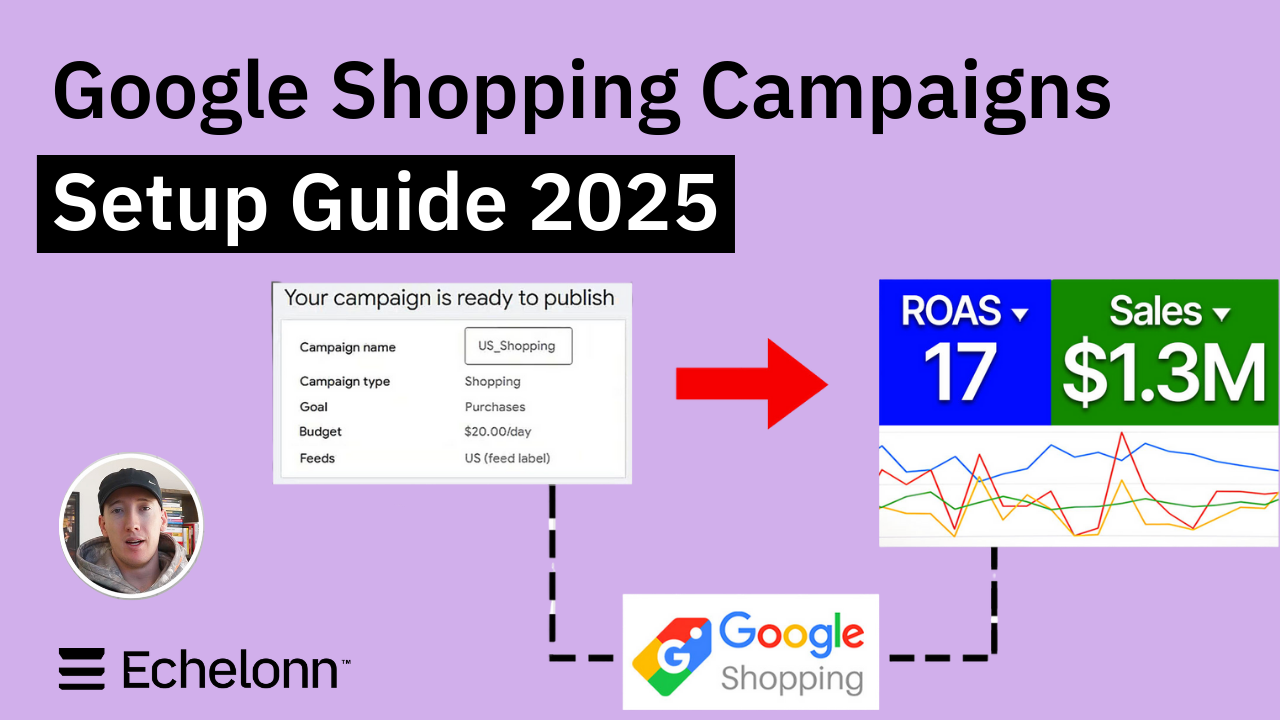
Google Shopping Campaigns Setup Guide 2025
Confessions of a Google Ads Auditor: The Worst Mistakes We See Inside eCom Accounts

How to Spy on Competitor Google Ads: Complete 2025 Guide
%20(2).png)
7 Questions to Ask Before Hiring a Google Ads Consultant
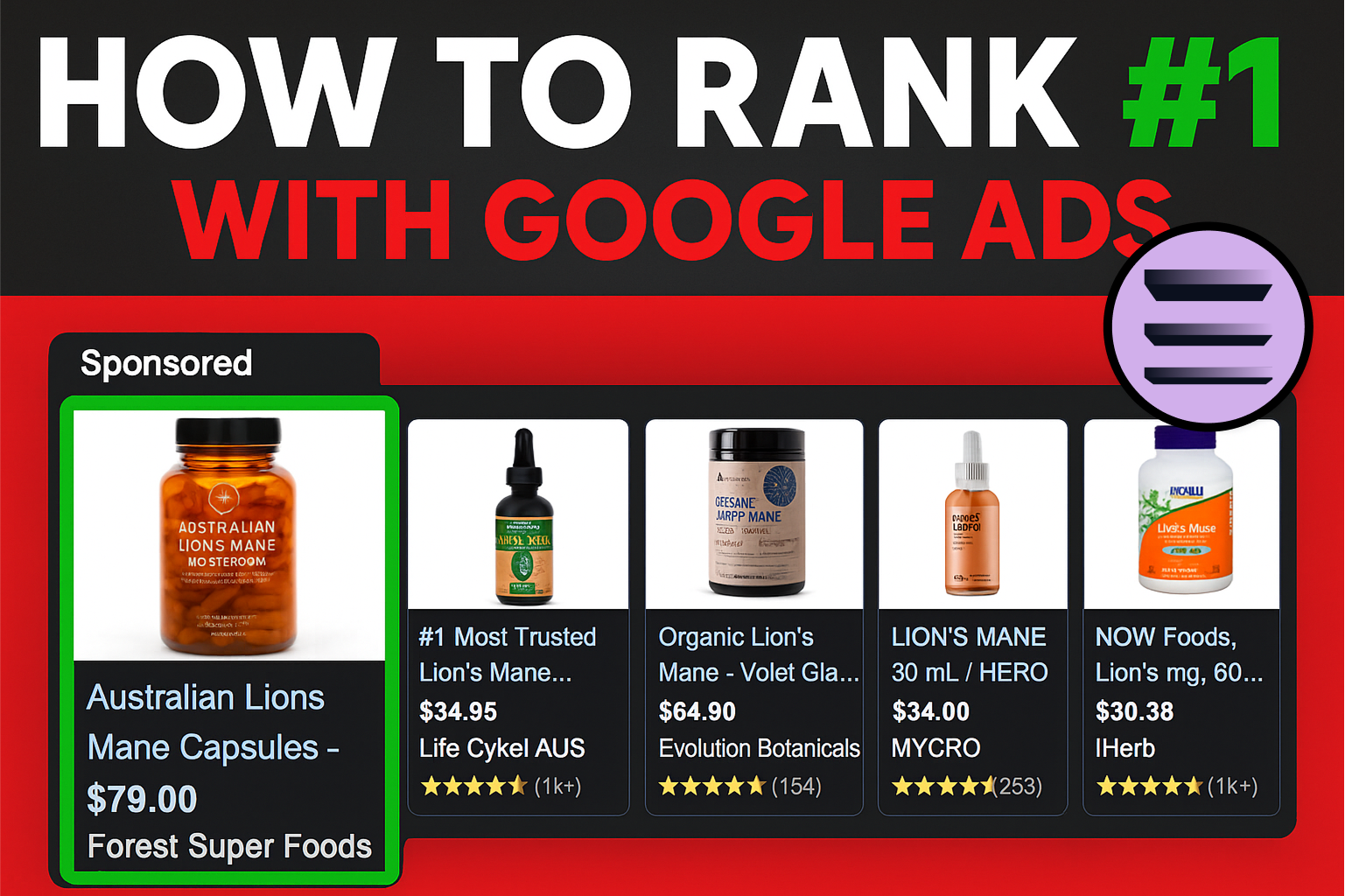
How to Rank #1 on Google Ads: Complete Shopping & Search Guide 2025
.png)
Learning Google Ads in 2025: The Roadmap Nobody Talks About
%20(1).png)
What Makes a Google Ads Specialist Worth $10,000/Month?

Why Cheap Google Ads Consulting Costs You $180,000+ in Lost Revenue
.png)
Why 99% of Google Ads Experts Fail (& How to Find One That Won’t)
.png)
5 Google Product Feed Fixes for eCom Growth
.png)
Google Ads Campaign Structure: Why 95% of Brands Waste Budget on Mixed Traffic

In-House vs Agency Google Ads: Which Delivers Better ROI in 2025?
.png)
How to Scale Google Ads With a Small Budget | Setup and Optimization

Google Shopping Optimization: 11 Proven Tactics for Maximum ROAS
%20(3).png)
eCom Growth Strategy: How We Scaled a Supplement Brand From $1.9M to $8.6M With Google Ads
%20(4).png)
Google Merchant Center Fix: How to Improve Rankings With Accurate Shipping Times

CTR Is Misunderstood by 95% of the PPC Industry (What to Optimise for Instead)
.png)
Google Ads AI | Manual vs Automated Campaign Performance

Complete YouTube Ads Guide 2025 | 3 Formats, 5 Principles, Proven Results
%20(2).png)
eCom Growth Strategy With Google Ads in 2025
.png)
Google Marketing Live 2025: 11 Key Takeaways for Marketers
%20(1).png)
YouTube Advertising Strategy: How to Drive Results Across Every Format
Google Shopping Feed Optimisation: Tips for Better Results

How Long Does it Take for Google Ads to Work?

YouTube Ads Analytics 101: Key Metrics and How to Use Them

Search Ad Strategies to Maximize Sales with Google ads for eCommerce (2024)

2025 Google Shopping Ads: Ultimate Guide, Benchmarks, and Pricing Breakdown

Maximizing ROI with Advanced Google Shopping Bid Strategies and Automated Bidding