
.svg)
Common Google Ads Myths That Cost Businesses Money


.png)
When businesses say Google Ads don’t work for them, the issue is rarely the platform itself. Google Ads is an auction system built around signals, data consistency, and bidding logic – and performance reflects how well those elements are structured. More often than not, it’s a misunderstanding of how the system operates, what it optimizes for, and what it needs to perform well.
Google Ads myths spread easily because the surface-level setup looks deceptively simple at first glance. You set a budget, choose keywords, turn campaigns on – and expect immediate, predictable results. When results fluctuate or fail to scale, the assumption is that the channel is broken or that it just doesn’t work for you. In reality, most underperformance comes from structural issues: weak conversion signals, unrealistic timelines, misaligned metrics, or unstable strategy. When signals are inconsistent, bidding becomes unstable – and volatility is misinterpreted as failure.
Below, we’ll unpack the most common Google Ads myths that quietly cost businesses money – not because they sound unreasonable, but because they distort expectations, influence strategic decisions, and ultimately affect performance stability over time.
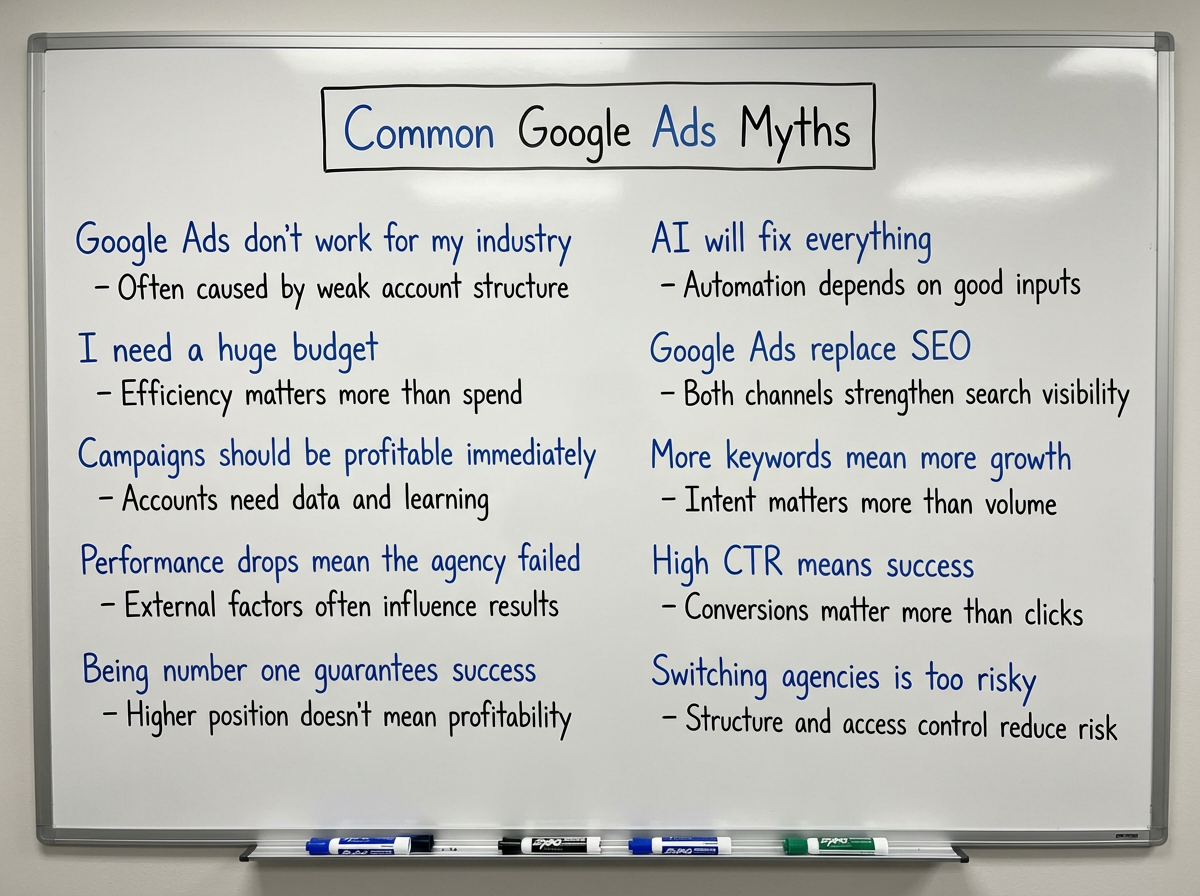
Myth #1: Google Ads Don’t Work for My Industry
Many businesses assume Google Ads simply “don’t work” for their industry. In reality, underperformance usually comes down to structural mistakes inside the account or missed optimization opportunities.
The video below walks through several common issues we frequently see in eCommerce Google Ads accounts – from poorly optimized product feeds to weak landing pages.
These types of issues are surprisingly common. When campaigns lack the right structure or optimization approach, it’s easy to assume the problem is the platform itself, when in reality the account simply needs stronger foundations and ongoing optimization.
Myth #2: I Need a Huge Budget to Get Good Results
The budget for Google Ads affects how much demand you can capture, not how efficiently the system can optimize campaigns. A bigger budget can deliver predictable results faster, but even accounts with smaller budgets can scale when their structure, targeting, and conversion signals are strong.
Another common Google Ads misconception is that spending more automatically secures the number one position in search results. However, Google Ads auctions are not determined by budget or bid alone. Ad Rank is influenced by factors such as ad relevance, expected CTR, and landing page experience. Accounts with strong structure, targeting, and landing pages can often outperform competitors with significantly larger budgets. Without these fundamentals, increasing ad spend usually amplifies inefficiencies rather than improving performance. In practice, this often leads to higher CPCs, unstable bidding behavior, and slower performance improvements despite higher spend.
Myth #3: Google Ads Should Deliver Immediate Profit
Businesses invest in paid search to get exposure, and, most importantly, profit. But Google Ads campaigns rarely become profitable immediately after launch. Most accounts require an initial learning phase and optimization period before performance stabilizes.
During the early phase, campaigns collect data about search behavior, conversion patterns, and bidding signals. This information allows bidding strategies and targeting to gradually improve efficiency. Without sufficient data, optimization decisions are based on limited signals, which can lead to inconsistent results in the beginning. Instead of focusing on instant profit, the priority should be building a stable data foundation first. Once the account gathers consistent signals, performance improvements and profitability become much more predictable.
Myth #4: If Performance Drops, the Agency Is the Problem
When performance declines, the first assumption is often that the agency is underperforming. While poor management can certainly affect results, Google Ads performance rarely depends on campaign management alone. Advertising outcomes are influenced by multiple external factors, including market competition, seasonality, pricing changes, product availability, and landing page performance. Even small shifts in these areas can affect conversion rates and cost efficiency.
For example, if competitors increase bids or launch aggressive promotions, your CPC can rise even if your campaigns are structured correctly. Similarly, changes on the website – such as slower page speed, new checkout friction, or weaker product pages – can reduce conversion rates without any change inside the Google Ads account.
Myth #5: Being Number 1 Guarantees Success
Some advertisers assume that the top ad position automatically delivers the best results. In reality, higher positions often come with significantly higher costs, without guaranteeing stronger profitability. Increasing bids to secure the number one spot can raise CPC without necessarily improving conversion rates.
For many businesses, the most efficient position is not the highest one, but the one where cost and conversion rate balance profitably. In some cases, slightly lower positions can generate similar conversion volume at a much lower CPA. This principle applies not only to search ads but also to formats like Shopping, where higher visibility does not always translate directly into stronger profitability. Instead of optimizing purely for visibility, successful advertisers focus on efficiency metrics: conversion rate, CPA, and ROAS.
Myth #6: AI Will Fix My Google Ads Account
With Google introducing more automation and AI features, many businesses assume the platform can largely manage itself. The expectation is that once the campaigns are launched, Google’s AI will automatically identify the right audiences, adjust bids, and generate strong performance with minimal oversight.
The video below explains why relying entirely on automation can lead to inefficient campaign structures and wasted spend.
AI plays a major role in modern Google Ads, particularly in areas like Smart Bidding and signal-based optimization. However, automation optimizes based on the inputs it receives. Campaign structure, targeting logic, and ad messaging still require human oversight. When automation optimizes around imperfect inputs, it often leads to inefficient traffic allocation, unstable bidding behavior, and less reliable optimization over time. Your Google Ads/PPC agency or internal team remains responsible for strategic decisions, structural adjustments, and ongoing optimization.
Myth #7: I Don’t Need SEO If I Run Google Ads
Some businesses treat SEO and Google Ads as competing channels, assuming paid traffic can fully replace organic visibility. But these two strategies work best when they support each other. Google Ads provides immediate visibility and allows businesses to test keywords, offers, and messaging quickly. SEO builds long-term organic traffic and credibility in search results. When both are aligned, businesses can capture more search demand and strengthen their presence across the results page.
For example, paid campaigns can reveal which keywords convert best, while SEO can expand organic visibility around the same topics. At the same time, strong organic rankings can reinforce brand trust when users see both paid and organic listings together.
Myth #8: More Keywords Mean More Growth
Targeting more keywords doesn’t automatically lead to more traffic and conversions. Expanding keyword lists without a clear strategy often introduces irrelevant searches and weakens campaign efficiency. Google Ads performs best when campaigns focus on high-intent keywords that closely match what a customer is actively searching for. Adding large numbers of loosely related queries can dilute relevance, increase wasted spend, and make performance analysis harder.
A relatively small set of well-researched, intent-driven keywords usually produces more predictable results than a broad list designed purely to increase reach. Clear keyword structure also improves ad relevance, landing page alignment, and bidding efficiency. This is why keyword expansion should be guided by intent and performance data rather than volume alone.
Myth #9: Impressions and CTR Are What Define Success
High impressions and click-through rates can look impressive in reports, but they don’t necessarily translate into profitable growth. These metrics measure visibility and engagement, not business outcomes. A campaign can generate thousands of impressions and a high CTR while still producing weak conversion rates or unprofitable CPA.
What ultimately matters is how efficiently traffic turns into revenue. Engagement metrics still have value, but they should be interpreted within a broader performance framework. Metrics such as conversion rate, CPA, and ROAS provide a clearer picture of whether campaigns are actually driving business results.
Myth #10: Switching Google Ads Agencies Is Too Risky
Many businesses delay changing agencies because they fear disrupting campaign performance. While transitions may carry short-term risk, the real problem usually isn’t the switch itself, but how the transition is handled. Performance instability typically occurs when account ownership, conversion tracking, or linked assets are not clearly controlled before the change happens. Without proper access to key assets and clear documentation of conversion tracking and account structure, even small adjustments can disrupt bidding signals and bidding signals or create data discontinuity.
When the underlying account structure remains intact, a Google Ads agency transition becomes far more predictable. Campaign management might change, but historical data and asset ownership remain preserved within the account. With the right preparation and clear asset ownership, switching agencies becomes a manageable operational transition rather than a structural risk.
The Bottom Line: Google Ads Don’t Fail – Strategy Does
Most Google Ads myths and misconceptions persist because they simplify a system that’s inherently strategic. When campaigns underperform, it’s tempting to blame the platform, the budget, or the competition. In reality, results usually reflect how well the account is structured, managed, and aligned with the business model and conversion signals.
Google Ads can be an extremely powerful growth channel, but only when decisions are based on reliable data, clear targeting, and consistent optimization. Metrics need to be interpreted in context, automation requires human oversight, and structural stability matters as much as day-to-day execution. When the foundation is strong, Google Ads stops being unpredictable and becomes a scalable and more predictable performance channel.

Ready To Start Scaling Today?
Scaling Your Favorite eCommerce Brands To The Highest Levels Through Google & YouTube Ads.

.svg)
Get Smarter About How To Scale Your Brand...
Discover Insider Knowledge On How We Scale Brands From 7 Figures All The Way Up To 8-9 Figures With Google Ads.
.svg)
.svg)
"The best Google ads agency there is. You only need to look at the quality of clients and the reviews to understand Jackson and his team are the real deal."

"One of the best in the agency space, great service and exceptional results. Since signing on with Jackson he has become one of our greatest assets when scaling."

"Top tier team & service delivery. Jackson is relentless when it comes to fulfilment & client needs. His attention to detail during the onboarding process ensured exponential results for my coaching business. If you're looking to elevate your ad results & learn a tone of new options/skills that can be implemented to drive more sales to your business then I'd strongly recommend Echelonn."

"From the very first conversation with Jackson and his team, it was clear that we had found a Google Ads agency that prioritises results above all else. Their collaboration between data-driven experts and a skilled copywriter creates a dynamic duo for Google advertising success..."

"Been working with them for 9 months and it's been a great experience. Jackson and his team know what they are doing and always goes above and beyond. If you're looking for a reliable Google ads agency this is the one."

"The best Google ads agency there is. You only need to look at the quality of clients and the reviews to understand Jackson and his team are the real deal."
"One of the best in the agency space, great service and exceptional results. Since signing on with Jackson he has become one of our greatest assets when scaling."
"Top tier team & service delivery. Jackson is relentless when it comes to fulfilment & client needs. His attention to detail during the onboarding process ensured exponential results for my coaching business. If you're looking to elevate your ad results & learn a tone of new options/skills that can be implemented to drive more sales to your business then I'd strongly recommend Echelonn."
"From the very first conversation with Jackson and his team, it was clear that we had found a Google Ads agency that prioritises results above all else. Their collaboration between data-driven experts and a skilled copywriter creates a dynamic duo for Google advertising success..."
"Been working with them for 9 months and it's been a great experience. Jackson and his team know what they are doing and always goes above and beyond. If you're looking for a reliable Google ads agency this is the one."
More Articles Like This.
Find answers to common queries about our services and how we can help you.
.svg)
How To Rank Your Google Shopping Ads Multiple Times
Why Your Google Ads Scale Breaks After $X Per Day
How to Tell if Your Google Ads Agency Is Underperforming
Why Your Performance Max Campaign Gets Clicks but No Sales
.png)
Why Your Google Ads Budget Isn't Spending (And How to Fix It)

The Right Way to Run Google Dynamic Search Ads
How to Get New Customers With Google Ads in 2026
Why Your Google Ads CPA Keeps Increasing and How to Reduce It
What Is a Good ROAS for eCommerce Businesses?
How to Set Up Google Ads Conversion Tracking the Right Way
How Much Does a Google Ads Agency Cost?
Why Your Google Ads Are Not Converting
.png)
Average CPC in Google Ads by Industry (And What It Means for Your Strategy)
Performance Max vs. Shopping Campaigns: Which One is Better?

Why Your Google Shopping Ads Get Impressions But No Clicks (Image Optimization Guide)
Why Your Google Ads Are Not Showing

YouTube Ads Targeting Framework That's Driven $10M+ for eCommerce Brands

What Professional Google Shopping Ads Management Looks Like
How Much Do Google Ads Cost in 2026?

Should Your Business Use Google Search Ads or Performance Max?

Performance Max Best Practices for Sustainable Growth
.png)
Google Shopping Ads Audience Targeting: What Actually Impacts Performance
.png)
How to Write Google Search Ads That Actually Convert
.png)
6 Google Shopping Feed Best Practices That Drive Better ROAS
%20(1).png)
How to Get Your Products Recommended by AI (ChatGPT, Google AI & More)
Common Google Ads Myths That Cost Businesses Money
.png)
7 Benefits of Google Shopping Ads for Your eCommerce Business
.png)
How to Switch Google Ads Agency Without Losing Performance or Data
.png)
Demand Capture vs Demand Generation: Where Google Ads Fits
.png)
How to Prepare Your Business for Working With a Google Ads Agency

How to Avoid Wasting Budget on the Wrong Searches With Google Ads Keyword Match Types
Google Ads Account Ownership: What Businesses Should Know Before Hiring an Agency
.png)
Landing Page Optimization Strategies That Increase Conversions
SEO and Google Ads: How Search Engine Optimization and Paid Search Work Together
Types of Remarketing in Google Ads: How Each One Works and When to Use It
Google Ads Keyword Research: How to Find Keywords That Actually Convert
.png)
What Is Google Performance Max and How Does It Work?
.png)
How Advertorials Support High-Intent Google Ads Funnels
%20(Canva%20Template).png)
How Audience Targeting Works in Google Search Ads (and When to Use It)

Google Ads for New Brands: What to Know Before Spending Your First Dollar
.png)
What Is a PPC Agency – and When It Makes Sense to Hire One
.png)
How to Improve Your Google Ads Conversion Rate

.png)
The Right Way to Link Shopify and Google Ads for Scalable Growth
Google Shopping Campaigns Setup Guide 2025
Confessions of a Google Ads Auditor: The Worst Mistakes We See Inside eCom Accounts

How to Spy on Competitor Google Ads: Complete 2025 Guide
%20(2).png)
7 Questions to Ask Before Hiring a Google Ads Consultant
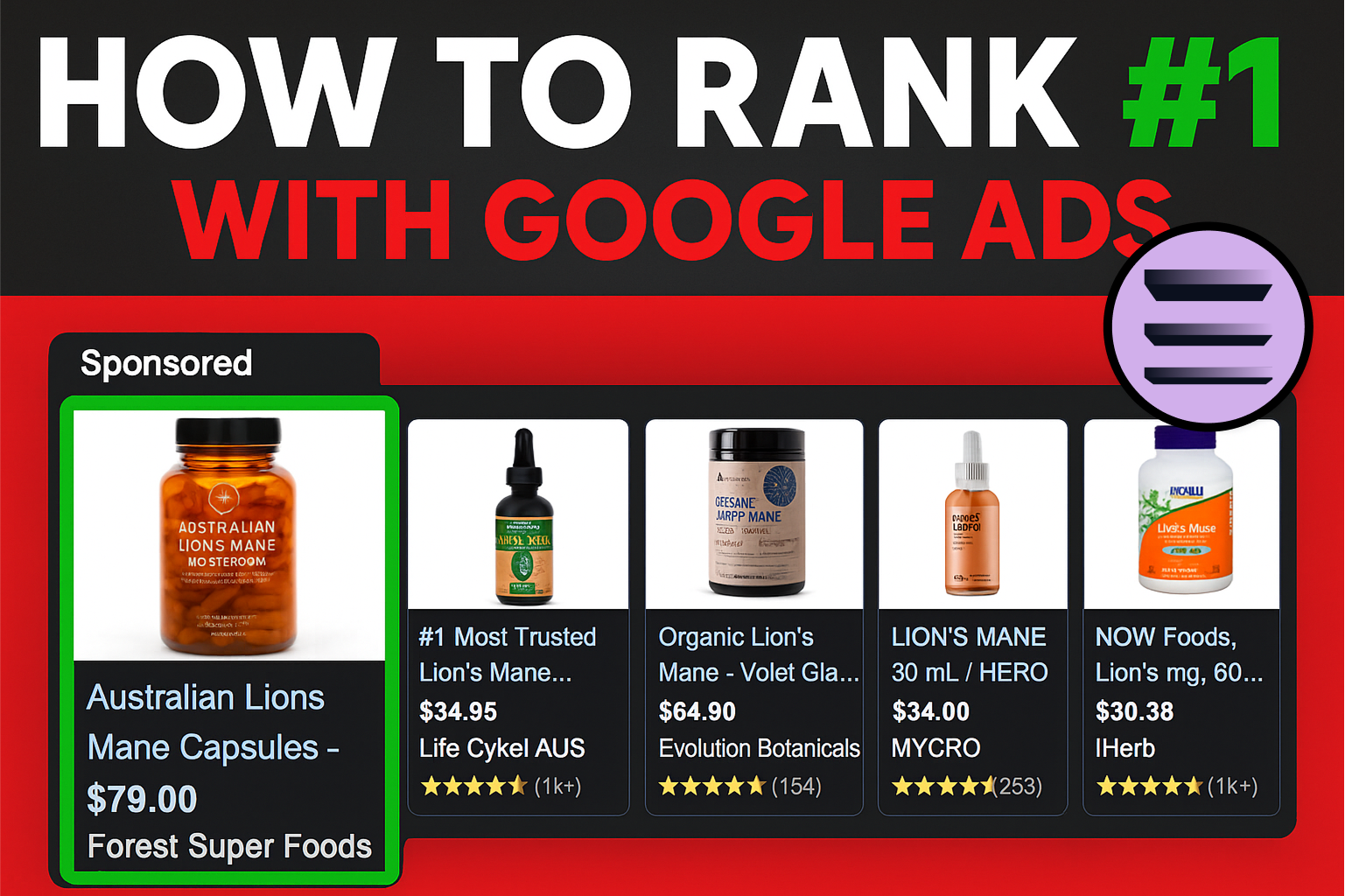
How to Rank #1 on Google Ads: Complete Shopping & Search Guide 2025
.png)
Learning Google Ads in 2025: The Roadmap Nobody Talks About
%20(1).png)
What Makes a Google Ads Specialist Worth $10,000/Month?

Why Cheap Google Ads Consulting Costs You $180,000+ in Lost Revenue
.png)
Why 99% of Google Ads Experts Fail (& How to Find One That Won’t)
.png)
5 Google Product Feed Fixes for eCom Growth
.png)
Google Ads Campaign Structure: Why 95% of Brands Waste Budget on Mixed Traffic

In-House vs Agency Google Ads: Which Delivers Better ROI in 2025?
.png)
How to Scale Google Ads With a Small Budget | Setup and Optimization

Google Shopping Optimization: 11 Proven Tactics for Maximum ROAS
%20(3).png)
eCom Growth Strategy: How We Scaled a Supplement Brand From $1.9M to $8.6M With Google Ads
%20(4).png)
Google Merchant Center Fix: How to Improve Rankings With Accurate Shipping Times

CTR Is Misunderstood by 95% of the PPC Industry (What to Optimise for Instead)
.png)
Google Ads AI | Manual vs Automated Campaign Performance

Complete YouTube Ads Guide 2025 | 3 Formats, 5 Principles, Proven Results
%20(2).png)
eCom Growth Strategy With Google Ads in 2025
.png)
Google Marketing Live 2025: 11 Key Takeaways for Marketers
%20(1).png)
YouTube Advertising Strategy: How to Drive Results Across Every Format
Google Shopping Feed Optimisation: Tips for Better Results

How Long Does it Take for Google Ads to Work?

YouTube Ads Cost in 2025: How to Launch & Optimize a YouTube Advertising Campaign

Search Ad Strategies to Maximize Sales with Google ads for eCommerce (2024)

2025 Google Shopping Ads: Ultimate Guide, Benchmarks, and Pricing Breakdown

Maximizing ROI with Advanced Google Shopping Bid Strategies and Automated Bidding