
.svg)
How to Avoid Wasting Budget on the Wrong Searches With Google Ads Keyword Match Types


Budget waste in Google Ads rarely happens because of bidding alone. In reality, it often starts earlier – at the search intent level.
Keyword match types determine which queries are allowed into your account. They define how strictly Google must interpret user intent before showing your ad. That means they shape traffic quality before bidding even begins. With Smart Bidding and automation, this becomes even more critical. Google optimizes based on the signals it receives. If those signals are diluted by low-intent queries or inconsistent search patterns, bidding stability can weaken, making performance less predictable over time.
When structured intentionally, match types create a more stable query environment. When they are not, variability increases across traffic quality, conversion patterns, and ROAS consistency.
Google Ads Keyword Match Types as an Intent Control System
Most discussions around keyword match types focus on definition: broad, phrase, exact. That framing is technical, but the real issue is structural.
Keyword match types are an intent control system. Each type determines how much interpretation Google can apply between your keyword and the user’s search query. The looser the structure, the more freedom the system has to expand into adjacent intent categories. This flexibility can support discovery and scale – but it also requires stronger signal quality to remain performance-efficient.
In Smart Bidding environments, signal precision matters. Smart Bidding strategies optimize towards observable conversion patterns. If your match type strategy allows a wide range of loosely related queries, those patterns become less consistent and harder for the system to model reliably.
Intent precision directly influences conversion consistency and bidding stability. When intent is tightly controlled, conversion behavior can become more predictable. When it is not, performance fluctuations are often attributed to seasonality, competition, or bidding strategy, while the root cause may lie in query expansion and keyword coverage. This is why keyword match types shouldn’t be seen as a technical keyword-level setting, but rather as structural mechanisms that shape the quality and consistency of the data your account depends on over time.
Broad Match: Expansion Tool, Not a Default Setting
Broad match gives Google the widest interpretative freedom. It allows the system to expand beyond close variations and capture related intent. Strategically, this makes broad match a growth mechanism. It is particularly useful for accounts that want to discover new query clusters, enter new markets, or already operate with strong and consistent conversion signals. However, the risk appears when broad match becomes the default structure rather than a deliberate expansion layer.
Because broad match increases query diversity, it also increases variation in purchase intent entering the account. Informational and loosely related searches can enter the auction, which changes the overall intent mix your campaigns optimize against. Smart Bidding optimizes based on observed outcomes. If intent becomes diluted, bidding adapts to a broader and less consistent signal environment.
Broad match works best when conversion tracking is accurate, purchase patterns are already stable, and high-intent segments are protected. Without that foundation, greater query variability can introduce revenue volatility and make ROAS less predictable over time. This is why expansion should build on signal stability, not replace it.
Phrase and Exact Match: Controlling Signal Quality
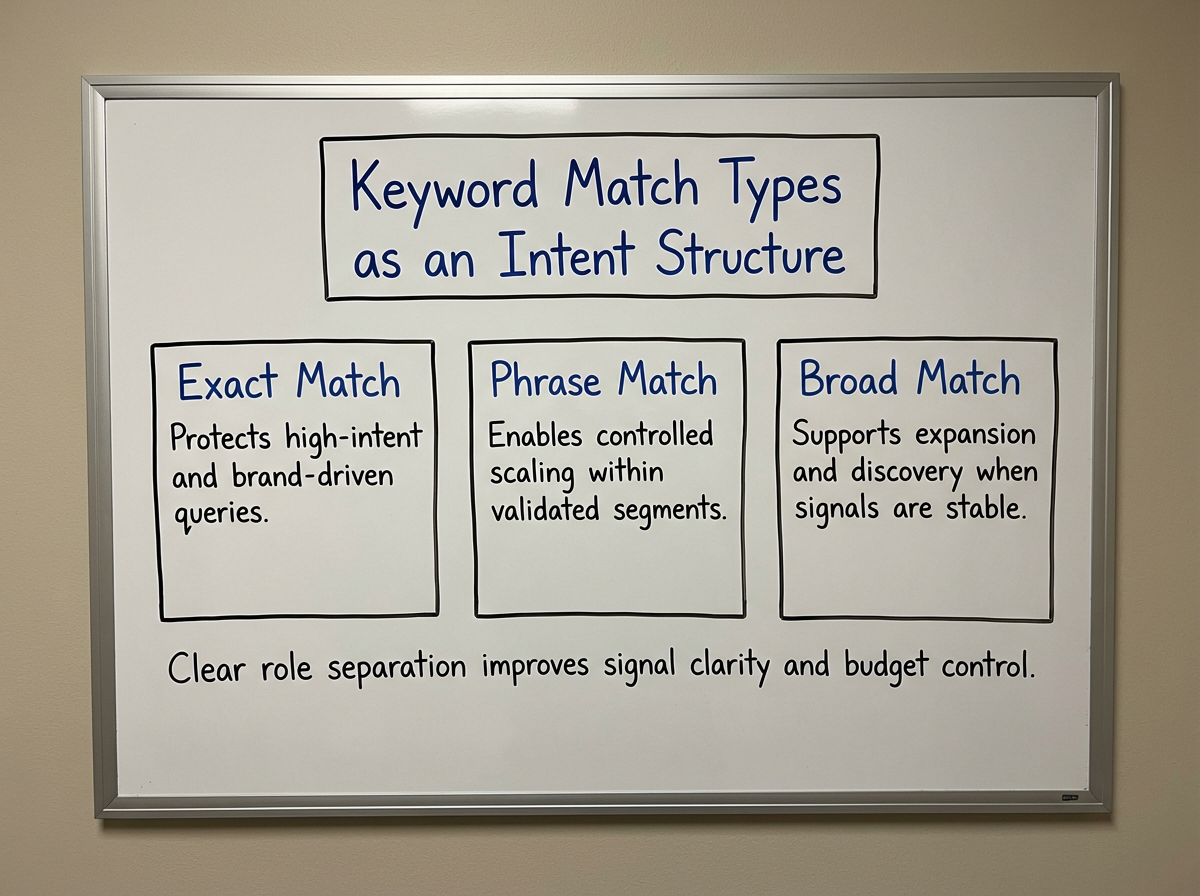
Phrase and exact match reduce interpretative freedom. They narrow the gap between your keyword and the user’s query. This is about protecting purchase intent, rather than limiting reach.
Phrase match allows controlled flexibility. It captures close variations while maintaining contextual alignment, which makes it suitable for scaling within validated product or category segments. Exact match goes even further – it prioritizes precision and is particularly effective for brand-driven or high-intent queries, where revenue impact and cost control matter most.
Another structural advantage of exact match lies in auction priority. Under Google’s identical search term rule, if a user’s query is identical (or a close variant) to your exact match keyword, that keyword will enter the auction over phrase or broad match versions of the same term. For example, if a user searches for “best hair loss shampoo” and your account contains broad, phrase, and exact versions of that keyword, the exact match version – best hair loss shampoo – will be prioritized. This priority helps protect high-intent queries from being interpreted through looser match types, reinforcing signal precision and improving control over how valuable searches are handled within the account.
Higher purchase intent control improves conversion consistency and supports more stable ROAS performance. Over time, this consistency supports more reliable forecasting and reduces the risk of scaling based on inconsistent signals. However, overly restrictive structures can also limit discovery, which is why phrase and exact match work best when they protect core revenue segments while expansion is managed deliberately elsewhere.
How Keyword Match Types Affect Account-Level Performance
Keyword match types influence the structure of data entering your Google Ads account. Queries that pass through your match type layer shape conversion patterns, bidding signals, Quality Score dynamics, and overall revenue predictability.
These structural differences are not only conceptual. Performance patterns across accounts consistently show that broad match tends to deliver lower average CPC and lower CTR due to wider auction participation and looser query alignment, while exact match typically achieves higher CTR given its tighter query alignment with the ad. Phrase match sits between the two, providing controlled reach with conversion efficiency that improves as keyword themes are validated and refined. The variation in results reflects how differently each match type captures and filters user intent.
Broad vs Phrase vs Exact: Structural Role in the Account
Each match type plays a different role in the account. Broad match supports expansion and discovery. Phrase match enables controlled scaling. Exact match protects high-intent and high-value queries.
When these roles are clearly separated, the account develops a more defined intent structure. When they mix without clear boundaries, intent layers collapse into one pool of signals, which can reduce signal clarity and make optimization less stable over time.
Impact on Bidding Stability
The more consistent the purchase behavior, the more predictable bid adjustments become. If match types introduce a wide variation in query intent, conversion behavior can become less stable. The algorithm adapts to this broader signal distribution, which can result in wider bid adjustments and less consistent cost control.
An inconsistent match type structure can increase bidding volatility and reduce performance predictability. Over time, this can make scaling more sensitive to budget changes. Budget increases may then drive cost growth faster than revenue growth, creating temporary ROAS instability instead of controlled expansion.
Impact on Quality Score and CPC
Query alignment influences ad relevance and expected CTR. When broader match types introduce loosely aligned queries, this alignment can weaken. Lower relevance may reduce Quality Score stability, which can lead to gradually higher CPC across the campaign.
Reduced query-to-ad alignment can gradually increase acquisition costs. Because these changes often appear as steady CPC increases rather than sudden spikes, accounts may require higher bids to maintain the same impression share or conversion volume. Over time, this can result in higher CPA or declining ROAS without any visible change in bidding strategy.
Impact on Forecasting and Scaling
Revenue forecasting depends on behavioral consistency. If traffic composition shifts frequently due to uncontrolled query expansion, historical performance becomes a less stable reference point. Forecasts may deviate more often, making budget planning less precise.
When budgets are increased in this environment, revenue may not grow proportionally to cost. Temporary ROAS declines or CPA increases can occur, requiring budget or bidding adjustments to restore balance.
Greater intent control improves revenue predictability and supports more controlled budget expansion. Match types therefore affect not only traffic quality, but also the reliability of growth decisions.
“Match type structure influences performance through a simple chain: Query Intent → Conversion Pattern → Smart Bidding Signal → Cost Efficiency → Revenue Predictability. Break the intent structure, and the entire chain becomes less stable.”
Common Mistakes With Keyword Match Types That Lead to Budget Waste
Expanding Before Signal Maturity
Broad match and heavy expansion work best when conversion patterns are already consistent. If revenue behavior is still volatile – fluctuating ROAS, unstable AOV, inconsistent purchase cycles – expansion can amplify variability instead of supporting sustainable growth.
Expanding before conversion patterns stabilize can increase spend faster than revenue growth. Over time, this can weaken performance signals, making it harder to evaluate true efficiency and to scale budgets with confidence.
Mixing Match Types Without Structure
Running broad, phrase, and exact in the same ad groups without clear role separation blurs intent layers within the account. High-intent queries compete with exploratory traffic. Bidding reacts to blended data instead of prioritized revenue segments.
Unstructured match type mixing weakens optimization clarity and reduces control over spend allocation. Over time, this can shift budget toward mixed-intent traffic instead of consistently supporting high-value queries.
Ignoring Search Term Volatility
Even with deliberate match type structuring, query behavior evolves over time. Seasonality, competition, and algorithmic interpretation influence traffic composition. Without regular search term analysis and negative keyword refinement, loosely aligned search terms can accumulate.
When query expansion remains unmonitored, traffic quality can decline and acquisition costs may become less consistent. Because these shifts often happen gradually, they may go unnoticed until ROAS or CPA trends begin to shift.
Conclusion: Control Intent to Protect Budget
Keyword match types shouldn’t be treated as technical settings, but rather as structural and strategic decisions. They determine how much freedom the system has in interpreting a user’s query. In an automated environment, that freedom directly affects signal clarity, bidding stability, and revenue predictability.
Broad match enables expansion, while phrase and exact match protect intent. The objective is growth built on clear intent structure. Control intent first – optimization becomes more predictable after that.

Ready To Start Scaling Today?
Scaling Your Favorite eCommerce Brands To The Highest Levels Through Google & YouTube Ads.

.svg)
Get Smarter About How To Scale Your Brand...
Discover Insider Knowledge On How We Scale Brands From 7 Figures All The Way Up To 8-9 Figures With Google Ads.
.svg)
.svg)
"The best Google ads agency there is. You only need to look at the quality of clients and the reviews to understand Jackson and his team are the real deal."

"One of the best in the agency space, great service and exceptional results. Since signing on with Jackson he has become one of our greatest assets when scaling."

"Top tier team & service delivery. Jackson is relentless when it comes to fulfilment & client needs. His attention to detail during the onboarding process ensured exponential results for my coaching business. If you're looking to elevate your ad results & learn a tone of new options/skills that can be implemented to drive more sales to your business then I'd strongly recommend Echelonn."

"From the very first conversation with Jackson and his team, it was clear that we had found a Google Ads agency that prioritises results above all else. Their collaboration between data-driven experts and a skilled copywriter creates a dynamic duo for Google advertising success..."

"Been working with them for 9 months and it's been a great experience. Jackson and his team know what they are doing and always goes above and beyond. If you're looking for a reliable Google ads agency this is the one."

"The best Google ads agency there is. You only need to look at the quality of clients and the reviews to understand Jackson and his team are the real deal."
"One of the best in the agency space, great service and exceptional results. Since signing on with Jackson he has become one of our greatest assets when scaling."
"Top tier team & service delivery. Jackson is relentless when it comes to fulfilment & client needs. His attention to detail during the onboarding process ensured exponential results for my coaching business. If you're looking to elevate your ad results & learn a tone of new options/skills that can be implemented to drive more sales to your business then I'd strongly recommend Echelonn."
"From the very first conversation with Jackson and his team, it was clear that we had found a Google Ads agency that prioritises results above all else. Their collaboration between data-driven experts and a skilled copywriter creates a dynamic duo for Google advertising success..."
"Been working with them for 9 months and it's been a great experience. Jackson and his team know what they are doing and always goes above and beyond. If you're looking for a reliable Google ads agency this is the one."
More Articles Like This.
Find answers to common queries about our services and how we can help you.
.svg)
Performance Max Audience Signals Explained
Google Ads Optimization Score: Should You Trust It?
What Is a Good CTR for Google Ads?
Why More Google Ads Spend Doesn't Always Mean More Revenue
How To Rank Your Google Shopping Ads Multiple Times
Why Your Google Ads Scale Breaks After $X Per Day
How to Tell if Your Google Ads Agency Is Underperforming
Why Your Performance Max Campaign Gets Clicks but No Sales
.png)
Why Your Google Ads Budget Isn't Spending (And How to Fix It)

The Right Way to Run Google Dynamic Search Ads
How to Get New Customers With Google Ads in 2026
Why Your Google Ads CPA Keeps Increasing and How to Reduce It
What Is a Good ROAS for eCommerce Businesses?
How to Set Up Google Ads Conversion Tracking the Right Way
How Much Does a Google Ads Agency Cost?
Why Your Google Ads Are Not Converting
.png)
Average CPC in Google Ads by Industry (And What It Means for Your Strategy)
Performance Max vs. Shopping Campaigns: Which One is Better?

Why Your Google Shopping Ads Get Impressions But No Clicks (Image Optimization Guide)
Why Your Google Ads Are Not Showing

YouTube Ads Targeting Framework That's Driven $10M+ for eCommerce Brands

What Professional Google Shopping Ads Management Looks Like
How Much Do Google Ads Cost in 2026?

Should Your Business Use Google Search Ads or Performance Max?

Performance Max Best Practices for Sustainable Growth
.png)
Google Shopping Ads Audience Targeting: What Actually Impacts Performance
.png)
How to Write Google Search Ads That Actually Convert
.png)
6 Google Shopping Feed Best Practices That Drive Better ROAS
%20(1).png)
How to Get Your Products Recommended by AI (ChatGPT, Google AI & More)
.png)
Common Google Ads Myths That Cost Businesses Money
.png)
7 Benefits of Google Shopping Ads for Your eCommerce Business
.png)
How to Switch Google Ads Agency Without Losing Performance or Data
.png)
Demand Capture vs Demand Generation: Where Google Ads Fits
.png)
How to Prepare Your Business for Working With a Google Ads Agency
How to Avoid Wasting Budget on the Wrong Searches With Google Ads Keyword Match Types
Google Ads Account Ownership: What Businesses Should Know Before Hiring an Agency
.png)
Landing Page Optimization Strategies That Increase Conversions
SEO and Google Ads: How Search Engine Optimization and Paid Search Work Together
Types of Remarketing in Google Ads: How Each One Works and When to Use It
Google Ads Keyword Research: How to Find Keywords That Actually Convert
.png)
What Is Google Performance Max and How Does It Work?
.png)
How Advertorials Support High-Intent Google Ads Funnels
%20(Canva%20Template).png)
How Audience Targeting Works in Google Search Ads (and When to Use It)

Google Ads for New Brands: What to Know Before Spending Your First Dollar
.png)
What Is a PPC Agency – and When It Makes Sense to Hire One
.png)
How to Improve Your Google Ads Conversion Rate

.png)
The Right Way to Link Shopify and Google Ads for Scalable Growth
Google Shopping Campaigns Setup Guide 2025
Confessions of a Google Ads Auditor: The Worst Mistakes We See Inside eCom Accounts
How to Spy on Competitor Google Ads: Complete 2025 Guide
%20(2).png)
7 Questions to Ask Before Hiring a Google Ads Consultant
How to Rank #1 on Google Ads: Complete Shopping & Search Guide 2025
.png)
Learning Google Ads in 2025: The Roadmap Nobody Talks About
%20(1).png)
What Makes a Google Ads Specialist Worth $10,000/Month?

Why Cheap Google Ads Consulting Costs You $180,000+ in Lost Revenue
.png)
Why 99% of Google Ads Experts Fail (& How to Find One That Won’t)
.png)
5 Google Product Feed Fixes for eCom Growth
.png)
Google Ads Campaign Structure: Why 95% of Brands Waste Budget on Mixed Traffic

In-House vs Agency Google Ads: Which Delivers Better ROI in 2025?
.png)
How to Scale Google Ads With a Small Budget | Setup and Optimization

Google Shopping Optimization: 11 Proven Tactics for Maximum ROAS
%20(3).png)
eCom Growth Strategy: How We Scaled a Supplement Brand From $1.9M to $8.6M With Google Ads
%20(4).png)
Google Merchant Center Fix: How to Improve Rankings With Accurate Shipping Times

CTR Is Misunderstood by 95% of the PPC Industry (What to Optimise for Instead)
.png)
Google Ads AI | Manual vs Automated Campaign Performance

Complete YouTube Ads Guide 2025 | 3 Formats, 5 Principles, Proven Results
%20(2).png)
eCom Growth Strategy With Google Ads in 2025
.png)
Google Marketing Live 2025: 11 Key Takeaways for Marketers
%20(1).png)
YouTube Advertising Strategy: How to Drive Results Across Every Format
Google Shopping Feed Optimisation: Tips for Better Results

How Long Does it Take for Google Ads to Work?

YouTube Ads Analytics 101: Key Metrics and How to Use Them

Search Ad Strategies to Maximize Sales with Google ads for eCommerce (2024)

2025 Google Shopping Ads: Ultimate Guide, Benchmarks, and Pricing Breakdown

Maximizing ROI with Advanced Google Shopping Bid Strategies and Automated Bidding