
.svg)
How to Switch Google Ads Agency Without Losing Performance or Data


.png)
Switching agencies is a normal part of business growth. Performance expectations evolve, internal teams change, and strategic priorities shift. But when you switch Google Ads agency, you are not just changing who manages your campaigns. You are changing who interacts with your data, your bidding signals, your conversion tracking, and your account structure.
This makes a Google Ads transition a structural change, not an operational one. The campaigns may continue running, but the underlying data and control layer is being transferred.
Many businesses approach agency changes as a handover process, without clearly defining what a Google Ads agency is responsible for versus what should remain under business control. In reality, it is a moment that can either preserve accumulated performance or unintentionally disrupt it. If ownership, tracking, and access are not handled correctly, bidding signals can destabilize and conversion behavior can become inconsistent. This article outlines how to change Google Ads agency safely – without losing data continuity, bidding stability, or strategic control over your advertising assets.
Why Switching a Google Ads Agency is a Structural Change, Not an Operational One
When you change Google Ads agency, campaign management shifts. But the account is your business asset – and it shouldn’t. The Google Ads account contains accumulated historical conversion data, bidding signals, audience learning, feed integrations, and structural decisions. These are not operational details that can simply be replaced or reset. They shape how Smart Bidding behaves and how predictably campaigns perform.
If the transition changes critical assets such as conversion tracking, Merchant Center feeds, or audience integrations, the system doesn’t interpret that as a simple management change, but as a structural disruption. Billing changes rarely affect bidding signals directly, but misconfigured payment profiles can still interrupt campaign delivery. Structural disruptions can directly affect performance stability because bidding systems rely on consistent signals and historical data.
Even if campaigns remain active, changes in conversion configuration, or account-level settings can destabilize signal consistency. This directly impacts bidding stability and can increase short-term CPA volatility.
Over time, repeated resets reduce the account’s ability to scale predictably. Forecasting becomes less reliable, and optimization decisions rely on fragmented data instead of continuous learning. This is why switching agencies should not begin with campaign edits straight away, but with structural clarity and asset control.
What You Must Control Before You Change Google Ads Agency
Google Ads Account Ownership
Your business should own the Google Ads account under its own email and manager structure, while also maintaining full administrative access internally. If the account is owned or structurally controlled by the agency, switching becomes a migration instead of a management transition, introducing unnecessary complexity and risk.
Ownership determines who controls historical data, access permissions, and long-term continuity. Full admin access ensures your internal team can protect account structure, linked assets, and configuration stability during the transition period – this is part of how you prepare for working with a Google Ads agency. Without both ownership and administrative control, performance stability and data integrity are exposed to unnecessary risk.
Conversion Tracking Definitions
Document how conversions are configured: primary vs secondary actions, attribution model, imported goals (GA4, CRM), enhanced conversions, and any offline tracking setup. If conversion definitions change during the transition, performance comparisons become unreliable. Even small adjustments can alter bidding behavior because Smart Bidding optimizes against defined primary actions. Historical consistency matters more than short-term refinements.
Linked Assets (GA4, Merchant Center, YouTube, CRM)
Verify which assets are linked at account level and who controls them. In eCommerce, Merchant Center ownership and feed access are critical for Shopping and Performance Max stability. Broken or reconfigured links can interrupt data signals used for bidding optimization, reducing signal consistency and affecting auction performance.
If product feeds are managed through manual sources such as Google Sheets, the business should also ensure it has appropriate access to the feed file (e.g. editor permissions) so it can be shared with the incoming agency and maintained without interruption.
Billing Structure and Payment Profile
Confirm that the payment profile is owned by the business and that ad spend reporting aligns with internal financial oversight. Billing ownership confusion often surfaces only after access is removed. Clarity here protects financial transparency during and after the transition, and prevents unexpected disruptions to campaign delivery.
Clear ownership, admin access, and stable tracking definitions protect accumulated learning and prevent signal disruption during a Google Ads agency transition. This directly supports bidding stability and conversion consistency in the first 30–60 days post-transition. Long term, structural control reduces dependency on individual partners and makes future transitions predictable rather than disruptive.
Protecting Performance During a Google Ads Agency Transition
Once structural control is secured, the priority shifts to performance stability. A Google Ads agency transition introduces uncertainty into the system – not because campaigns automatically decline, but because bidding models rely on consistent signals, stable conversion definitions, and predictable structural patterns. When multiple variables change simultaneously, optimization becomes reactive rather than controlled.
There are three common sources of performance volatility during an agency transition:
- Immediate campaign restructuring
New agencies often want to implement their preferred structure quickly. While structural improvements may be valid, large-scale changes in the first weeks can reset learning phases and disrupt historical signal patterns, reducing bidding stability in the short term.
- Conversion tracking adjustments
Altering primary conversions, attribution settings, or imported goals during the transition makes performance comparisons unreliable. Even small definitional changes can affect Smart Bidding behavior, because the system recalibrates against newly defined objectives. If new conversion tracking is introduced, it is often safer to run it in parallel for a period of time (for example around 30 days) and compare the data against the current primary conversions before switching the optimization signal.
- Parallel strategic shifts
Changing targeting logic, bidding strategies, and budget allocation at the same time makes it difficult to isolate what drives performance changes. This complicates decision-making, increases short-term CPA volatility, and weakens forecasting reliability.
The principle is simple: preserve continuity first, introduce improvements second. Sudden structural and strategic shifts during a Google Ads agency transition can destabilize bidding signals and fragment performance data. Over time, a disciplined, phased transition protects accumulated learning and supports predictable scaling under new management.
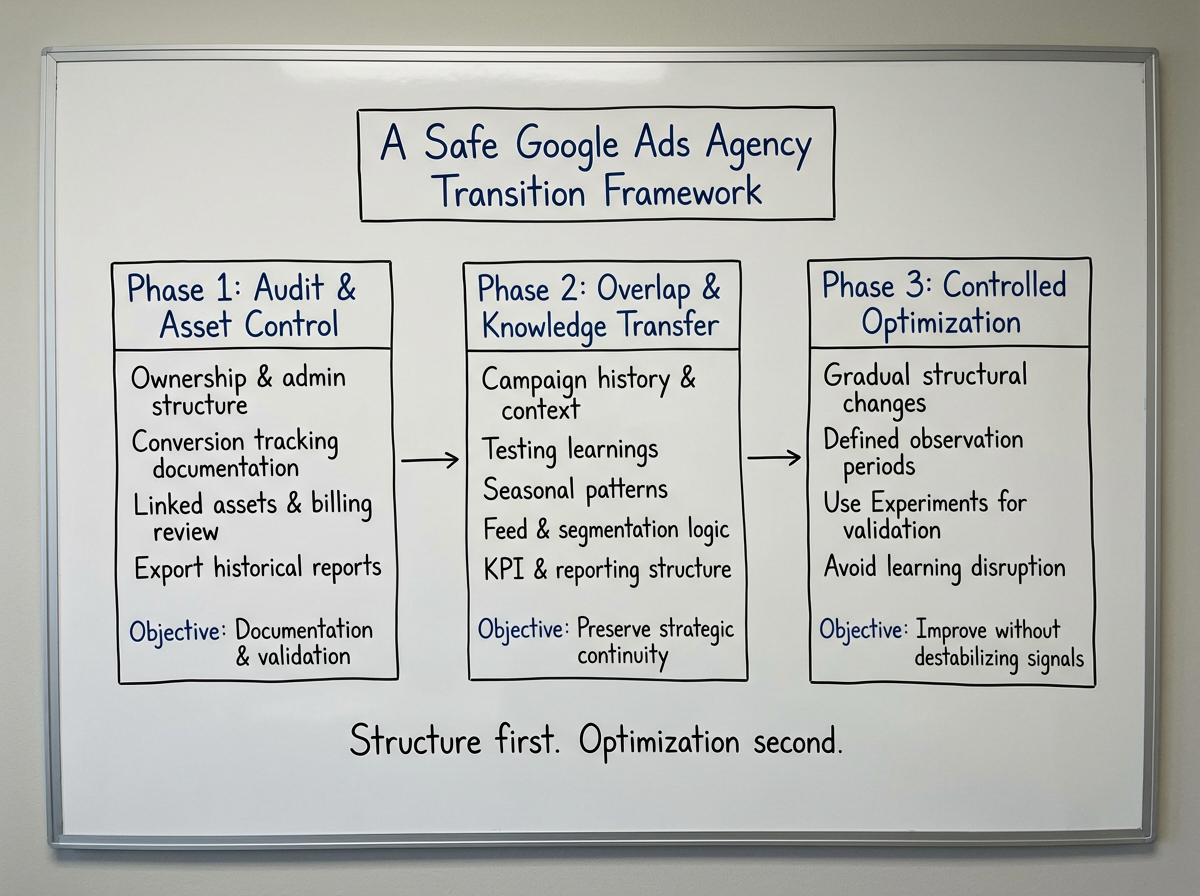
A Safe Google Ads Agency Transition Framework
Phase 1: Audit & Asset Control
Before any operational adjustments are made, conduct a structural audit of the current account environment. It may be conducted with agency support, but oversight should remain internal.
This includes verifying account ownership and admin hierarchy, documenting conversion tracking definitions, mapping linked assets, exporting key historical reports, and reviewing billing configuration. The purpose of this phase is documentation and validation, not optimization.
Every asset and configuration layer should be clearly understood before responsibility shifts. Securing asset control and documenting tracking setups preserves historical data integrity and protects bidding continuity. Without this step, signal gaps and configuration inconsistencies often surface weeks later, when performance comparisons are already unreliable.
Phase 2: Overlap & Knowledge Transfer
If possible, create a short overlap period between the current and incoming agencies. This phase should focus on documenting and transferring:
- existing and planned campaigns with historical context
- previous testing frameworks and learnings
- seasonal performance patterns
- feed logic and product segmentation strategy
- reporting structure and KPI definitions
Removing the previous agency before documentation is complete creates unnecessary friction and interpretation risk. A controlled overlap period reduces data gaps and supports stable decision-making during the transition. It also minimizes the risk of misaligned optimization decisions in the first weeks under new management. This phase strengthens long-term continuity by preserving historical context and maintaining consistent access to strategic information.
Phase 3: Controlled Optimization
Once structure is secured and knowledge is transferred, optimization can begin. At this stage, the objective shifts from preservation to performance improvement, but without destabilizing the system.
Instead of immediately restructuring campaigns or adjusting bidding strategies, changes should be introduced in defined stages, with clear observation periods between them – ideally validated through controlled testing frameworks such as Google Ads Experiments.
This approach allows performance shifts to be evaluated with context and reduces the risk of unnecessary learning disruption. By separating structural adjustments from strategic refinements, the account maintains signal consistency while improvements are introduced. Over time, this disciplined implementation creates a stable optimization environment and enables scalable growth under new management.
“Common Structural Mistakes During Agency Transitions:
– Creating a new account instead of transferring access
– Resetting conversion tracking definitions
– Changing billing ownership without audit
– Removing the previous agency before full documentation”
The Bottom Line: Control the Structure to Protect Performance
Switching agencies is a strategic decision, but it should not mean losing control over your advertising infrastructure. When you switch Google Ads agency, the objective is to preserve data continuity, bidding stability, and structural clarity. Performance improvements can follow, but stability must come first.
Campaign execution can change, but ownership and asset control should remain constant. Choosing the right Google Ads experts ensures that new management builds on a stable structure rather than resetting it. A Google Ads agency transition becomes risky when structure and tracking are treated as operational details instead of strategic assets. Handled correctly, changing agency is not a reset, but a controlled continuation – new management operating on an intact system.

Ready To Start Scaling Today?
Scaling Your Favorite eCommerce Brands To The Highest Levels Through Google & YouTube Ads.

.svg)
Get Smarter About How To Scale Your Brand...
Discover Insider Knowledge On How We Scale Brands From 7 Figures All The Way Up To 8-9 Figures With Google Ads.
.svg)
.svg)
"The best Google ads agency there is. You only need to look at the quality of clients and the reviews to understand Jackson and his team are the real deal."

"One of the best in the agency space, great service and exceptional results. Since signing on with Jackson he has become one of our greatest assets when scaling."

"Top tier team & service delivery. Jackson is relentless when it comes to fulfilment & client needs. His attention to detail during the onboarding process ensured exponential results for my coaching business. If you're looking to elevate your ad results & learn a tone of new options/skills that can be implemented to drive more sales to your business then I'd strongly recommend Echelonn."

"From the very first conversation with Jackson and his team, it was clear that we had found a Google Ads agency that prioritises results above all else. Their collaboration between data-driven experts and a skilled copywriter creates a dynamic duo for Google advertising success..."

"Been working with them for 9 months and it's been a great experience. Jackson and his team know what they are doing and always goes above and beyond. If you're looking for a reliable Google ads agency this is the one."

"The best Google ads agency there is. You only need to look at the quality of clients and the reviews to understand Jackson and his team are the real deal."
"One of the best in the agency space, great service and exceptional results. Since signing on with Jackson he has become one of our greatest assets when scaling."
"Top tier team & service delivery. Jackson is relentless when it comes to fulfilment & client needs. His attention to detail during the onboarding process ensured exponential results for my coaching business. If you're looking to elevate your ad results & learn a tone of new options/skills that can be implemented to drive more sales to your business then I'd strongly recommend Echelonn."
"From the very first conversation with Jackson and his team, it was clear that we had found a Google Ads agency that prioritises results above all else. Their collaboration between data-driven experts and a skilled copywriter creates a dynamic duo for Google advertising success..."
"Been working with them for 9 months and it's been a great experience. Jackson and his team know what they are doing and always goes above and beyond. If you're looking for a reliable Google ads agency this is the one."
More Articles Like This.
Find answers to common queries about our services and how we can help you.
.svg)
Performance Max Audience Signals Explained
Google Ads Optimization Score: Should You Trust It?
What Is a Good CTR for Google Ads?
Why More Google Ads Spend Doesn't Always Mean More Revenue
How To Rank Your Google Shopping Ads Multiple Times
Why Your Google Ads Scale Breaks After $X Per Day
How to Tell if Your Google Ads Agency Is Underperforming
Why Your Performance Max Campaign Gets Clicks but No Sales
.png)
Why Your Google Ads Budget Isn't Spending (And How to Fix It)

The Right Way to Run Google Dynamic Search Ads
How to Get New Customers With Google Ads in 2026
Why Your Google Ads CPA Keeps Increasing and How to Reduce It
What Is a Good ROAS for eCommerce Businesses?
How to Set Up Google Ads Conversion Tracking the Right Way
How Much Does a Google Ads Agency Cost?
Why Your Google Ads Are Not Converting
.png)
Average CPC in Google Ads by Industry (And What It Means for Your Strategy)
Performance Max vs. Shopping Campaigns: Which One is Better?

Why Your Google Shopping Ads Get Impressions But No Clicks (Image Optimization Guide)
Why Your Google Ads Are Not Showing

YouTube Ads Targeting Framework That's Driven $10M+ for eCommerce Brands

What Professional Google Shopping Ads Management Looks Like
How Much Do Google Ads Cost in 2026?

Should Your Business Use Google Search Ads or Performance Max?

Performance Max Best Practices for Sustainable Growth
.png)
Google Shopping Ads Audience Targeting: What Actually Impacts Performance
.png)
How to Write Google Search Ads That Actually Convert
.png)
6 Google Shopping Feed Best Practices That Drive Better ROAS
%20(1).png)
How to Get Your Products Recommended by AI (ChatGPT, Google AI & More)
.png)
Common Google Ads Myths That Cost Businesses Money
.png)
7 Benefits of Google Shopping Ads for Your eCommerce Business
How to Switch Google Ads Agency Without Losing Performance or Data
.png)
Demand Capture vs Demand Generation: Where Google Ads Fits
.png)
How to Prepare Your Business for Working With a Google Ads Agency

How to Avoid Wasting Budget on the Wrong Searches With Google Ads Keyword Match Types
Google Ads Account Ownership: What Businesses Should Know Before Hiring an Agency
.png)
Landing Page Optimization Strategies That Increase Conversions
SEO and Google Ads: How Search Engine Optimization and Paid Search Work Together
Types of Remarketing in Google Ads: How Each One Works and When to Use It
Google Ads Keyword Research: How to Find Keywords That Actually Convert
.png)
What Is Google Performance Max and How Does It Work?
.png)
How Advertorials Support High-Intent Google Ads Funnels
%20(Canva%20Template).png)
How Audience Targeting Works in Google Search Ads (and When to Use It)

Google Ads for New Brands: What to Know Before Spending Your First Dollar
.png)
What Is a PPC Agency – and When It Makes Sense to Hire One
.png)
How to Improve Your Google Ads Conversion Rate

.png)
The Right Way to Link Shopify and Google Ads for Scalable Growth
Google Shopping Campaigns Setup Guide 2025
%20(2).png)
Should You Run Google Ads for Your Website? (Honest Answer)
Confessions of a Google Ads Auditor: The Worst Mistakes We See Inside eCom Accounts

How to Spy on Competitor Google Ads: Complete 2025 Guide
%20(2).png)
7 Questions to Ask Before Hiring a Google Ads Consultant
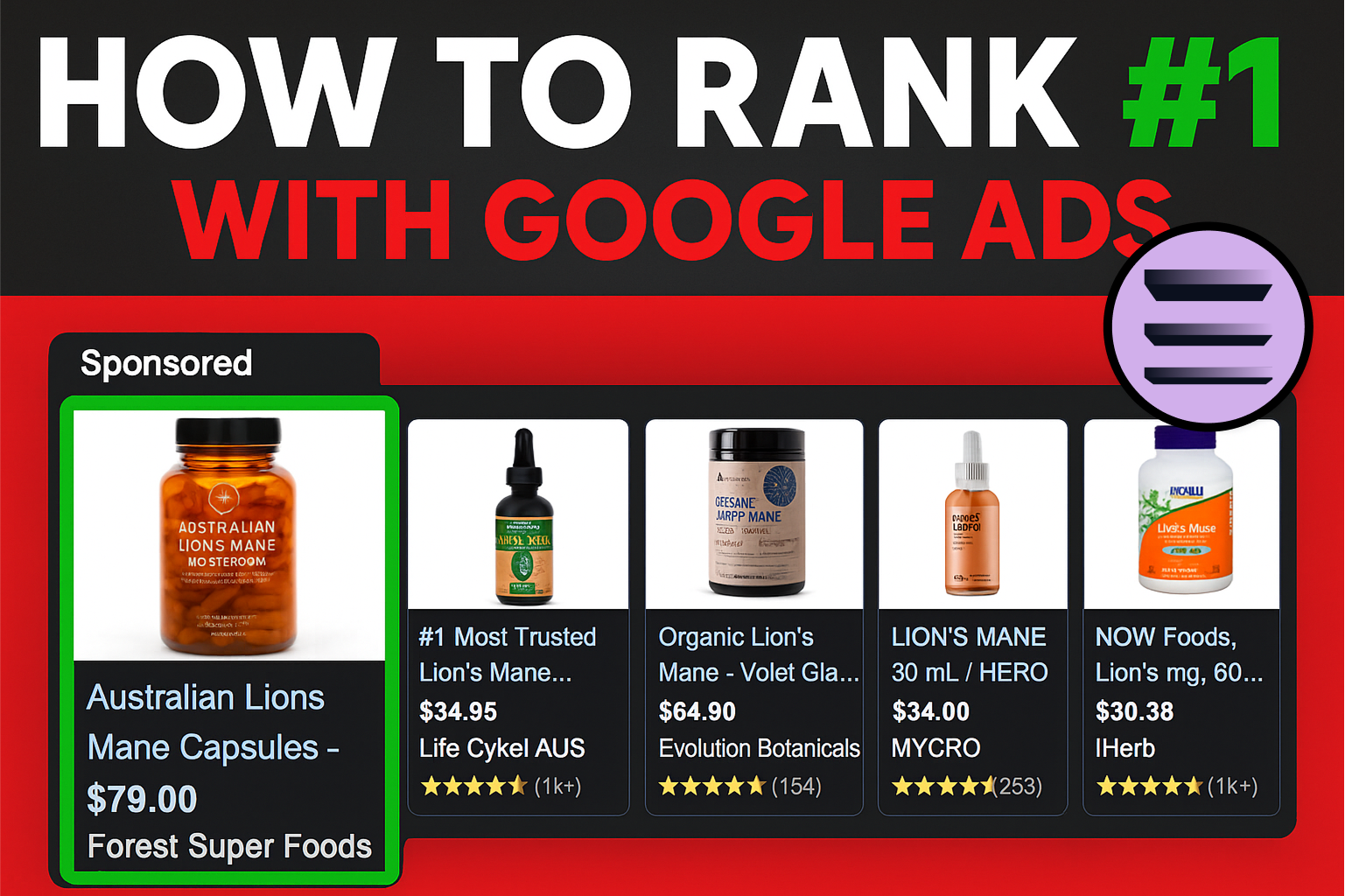
How to Rank #1 on Google Ads: Complete Shopping & Search Guide 2025
.png)
Learning Google Ads in 2025: The Roadmap Nobody Talks About
%20(1).png)
What Makes a Google Ads Specialist Worth $10,000/Month?

Why Cheap Google Ads Consulting Costs You $180,000+ in Lost Revenue
.png)
Why 99% of Google Ads Experts Fail (& How to Find One That Won’t)
.png)
5 Google Product Feed Fixes for eCom Growth
.png)
Google Ads Campaign Structure: Why 95% of Brands Waste Budget on Mixed Traffic

In-House vs Agency Google Ads: Which Delivers Better ROI in 2025?
.png)
How to Scale Google Ads With a Small Budget | Setup and Optimization

Google Shopping Optimization: 11 Proven Tactics for Maximum ROAS
%20(3).png)
eCom Growth Strategy: How We Scaled a Supplement Brand From $1.9M to $8.6M With Google Ads
%20(4).png)
Google Merchant Center Fix: How to Improve Rankings With Accurate Shipping Times

CTR Is Misunderstood by 95% of the PPC Industry (What to Optimise for Instead)
.png)
Google Ads AI | Manual vs Automated Campaign Performance

Complete YouTube Ads Guide 2025 | 3 Formats, 5 Principles, Proven Results
%20(2).png)
eCom Growth Strategy With Google Ads in 2025
.png)
Google Marketing Live 2025: 11 Key Takeaways for Marketers
%20(1).png)
YouTube Advertising Strategy: How to Drive Results Across Every Format
Google Shopping Feed Optimisation: Tips for Better Results

How Long Does it Take for Google Ads to Work?

YouTube Ads Cost in 2025: How to Launch & Optimize a YouTube Advertising Campaign

Search Ad Strategies to Maximize Sales with Google ads for eCommerce (2024)

2025 Google Shopping Ads: Ultimate Guide, Benchmarks, and Pricing Breakdown

Maximizing ROI with Advanced Google Shopping Bid Strategies and Automated Bidding