
.svg)
Why More Google Ads Spend Doesn't Always Mean More Revenue


Growth stalls, and the reflex is always the same: increase the budget. Sometimes it works. Just as often, revenue stays flat, or drops, while cost climbs.
Budget is one input into a system, not the system itself. Increasing it doesn't add revenue directly. It shows whether the rest of the setup – the size of the potential audience, the account structure, the feed, bid strategy targets, and the margin – can actually support more spend. If any part of that chain is already the constraint, more money just gets spent faster. It doesn't buy you more customers.
The question, then, isn't whether you should increase the budget. It's whether the account is actually ready to turn that additional spend into profitable revenue.
What Actually Happens When You Push More Budget
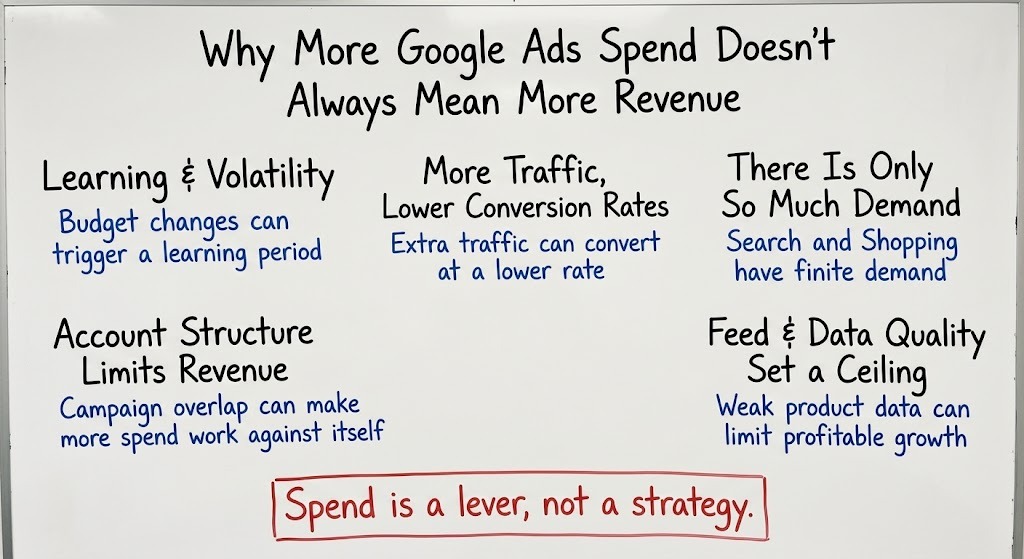
Learning And Volatility
Automated bidding strategies calibrate against the data they're given. Google's own documentation on bid strategy learning explains that significant changes to bidding, settings, or campaign composition can cause campaigns to enter a Learning status as the system recalibrates. These changes can also create short-term volatility in performance while the system adjusts.
A practical approach is to increase budgets by around 20 % at a time and give the campaign a few days before scaling again, adjusting the pace based on conversion volume, bidding strategy, and performance. Before you increase the budget, it's also worth checking whether the campaign is generating enough conversions for Smart Bidding to learn from. As a practical benchmark, we like to see around one to two conversions a day (or 30 to 50 per month, depending on the bidding strategy) before making more aggressive budget increases. The more consistent conversion data a campaign has, the more confidently you can scale it.
More Traffic, Lower Conversion Rates
Every account has a ceiling on how much genuinely high-intent traffic exists for it, at a given moment, in a given market. Push spend past what your current inventory and conversion signal can efficiently absorb, and the extra traffic the algorithm finds tends to convert at a lower rate than what you were already getting.
That's not a claim about how the auction works internally. It's what shows up in the numbers: as spend increases, revenue keeps growing, but at a slower rate. The more you spend, the larger that gap becomes.
Why More Google Ads Spend Doesn't Always Mean More Revenue: The Most Common Reasons
Revenue in a Google Ads account moves through a chain: budget funds demand capture, demand capture depends on traffic quality, and traffic quality and margin determine how much value that traffic can generate. Increasing budget only helps if the constraint is the amount of traffic you can capture. If the constraint is somewhere else, extra spend just gets absorbed without moving the outcome.
There Is Only So Much Demand
In some accounts, most of the available Search and Shopping demand for their category is already captured. Adding budget there doesn't create new searchers, it just bids more aggressively for the same pool of people who were already looking.
Search and Shopping are primarily demand-capture channels: they work with demand that already exists. Demand Gen can play a different role by helping reach audiences earlier in the buying journey, before they actively search. If the real ceiling is demand, not budget, that's where the incremental spend needs to go, not into the campaigns already fighting over the same searches.
Account Structure Limits Revenue
Sometimes, the issue is not the budget, but the account and campaign structure.
We audited a £6.2M-revenue company where Shopping campaigns were segmented by product type instead of margin. High-margin SKUs and loss-leading products were competing directly for the same budget inside the same campaigns, with no way to prioritise one over the other. There was also no category-level negative keyword structure, so Search, Shopping, and Performance Max were heavily overlapping across the same queries, reducing control over traffic allocation and creating inefficient spend without adding meaningful incremental volume.
In that account, adding budget on top of that structure wouldn't have fixed anything. It would have fed more spend into a setup that was already fighting itself.
Feed And Data Quality Set a Ceiling
The product feed itself is sometimes the constraint. In one case, product titles were built almost entirely around branded terms with minimal prospecting keywords, so campaigns captured very few non-branded search terms and struggled to reach new customers regardless of budget. A single, undifferentiated feed was also being used across both branded and prospecting campaigns, which meant neither could be optimised independently, and out-of-stock products weren't being excluded, so spend was going toward inventory that couldn't convert in the first place.
None of that is a budget problem. It's a data problem that happens to look like one, because the symptom is identical either way: revenue can fail to move despite higher spend. If feed quality is the suspect, these are the fixes worth checking first.
Bid Strategy Targets Can Limit Spend
A restrictive tROAS or tCPA target can limit how much a campaign is able to spend. Increasing a campaign's budget from $1K to $2K per day won't necessarily increase spend if the campaign is only spending $500 because the bid strategy is restricting auction participation.
In that situation, the budget isn't the constraint. The bidding target is. Before assuming a campaign needs more budget, check whether the bid strategy is actually allowing it to access enough auctions to spend the budget available.
“More spend can create more revenue – but only when the account is ready to absorb it profitably.”
How To Increase Spend Without Destroying Efficiency
Once the structural issues are out of the way, and the constraint genuinely is the budget, scaling comes down to how you increase spend.
Increase gradually: Increase budgets in steps rather than making large jumps, and give each step a few days before increasing again. This shows up consistently enough across different campaign types that it's worth defaulting to it rather than treating it as optional.
Direct the incremental budget deliberately: Extra spend tends to perform better going into campaigns that are already showing a strong conversion signal and have room to scale than spread thin across everything at once. A campaign with proven efficiency can often scale further before the quality of its additional traffic starts to decline.
Fix the structure before you fund it: If campaigns are competing against each other for the same queries, or budget isn't aligned with margin, scaling first and fixing structure later just means you're scaling the problem too. In the £6.2M account mentioned earlier, the first phase of the engagement wasn't about increasing budget at all, it was restructuring Shopping and Performance Max around CPA targets by product economics and building a category-level negative keyword framework. Controlled scaling only started once that foundation was in place, and revenue increased 133% within the second month of working together, once the structure could actually support the extra spend.
When Aggressive Scaling Actually Works
None of this means slow is always right. We've scaled budgets fast, and it's worked, when the groundwork was already there.
In one account, a Demand Gen campaign went from $8.4K to $70.7K in spend in a single month, an 8.4x increase, and held a 1.1x ROAS while generating 1,388 purchases. That one campaign, in that one month, generated more purchases than the entire account had the month before. It worked because three things were already true: the creative resonated with the audience, the landing page converted, and the bid strategy could absorb rapid budget increases without losing efficiency. Even with all three in place, it took a full month of daily performance checks and cautious step-ups to get the campaign to a place where it could take that level of spend.
In another account, we scaled budgets 50x over four months while prospecting stayed above a 2.2x ROAS target, closing one month at 2.85x. What made that possible wasn't the pace of the scaling itself, but clean measurement, a strict split between brand and prospecting spend, and a clear ROAS target that budget increases weren't allowed to push below. Scaling only stops putting profitability at risk when those things are already in place before you start, not after.
The Bottom Line: Spend Is A Lever, Not A Strategy
More budget is not necessarily a growth strategy. It's a lever you pull once you know that budget is actually the constraint on revenue, rather than demand, account structure, feed quality, bid strategy targets, or margin.
Before increasing spend, check whether the account has already captured most of the available demand, whether campaigns are competing against each other for the same searches, and whether the feed can actually support new customer acquisition. If those are solid, scale deliberately: gradual steps, into campaigns already proving efficiency, with clear triggers for when to hold or pull back.

Ready To Start Scaling Today?
Scaling Your Favorite eCommerce Brands To The Highest Levels Through Google & YouTube Ads.

.svg)
Get Smarter About How To Scale Your Brand...
Discover Insider Knowledge On How We Scale Brands From 7 Figures All The Way Up To 8-9 Figures With Google Ads.
.svg)
.svg)
"The best Google ads agency there is. You only need to look at the quality of clients and the reviews to understand Jackson and his team are the real deal."

"One of the best in the agency space, great service and exceptional results. Since signing on with Jackson he has become one of our greatest assets when scaling."

"Top tier team & service delivery. Jackson is relentless when it comes to fulfilment & client needs. His attention to detail during the onboarding process ensured exponential results for my coaching business. If you're looking to elevate your ad results & learn a tone of new options/skills that can be implemented to drive more sales to your business then I'd strongly recommend Echelonn."

"From the very first conversation with Jackson and his team, it was clear that we had found a Google Ads agency that prioritises results above all else. Their collaboration between data-driven experts and a skilled copywriter creates a dynamic duo for Google advertising success..."

"Been working with them for 9 months and it's been a great experience. Jackson and his team know what they are doing and always goes above and beyond. If you're looking for a reliable Google ads agency this is the one."

"The best Google ads agency there is. You only need to look at the quality of clients and the reviews to understand Jackson and his team are the real deal."
"One of the best in the agency space, great service and exceptional results. Since signing on with Jackson he has become one of our greatest assets when scaling."
"Top tier team & service delivery. Jackson is relentless when it comes to fulfilment & client needs. His attention to detail during the onboarding process ensured exponential results for my coaching business. If you're looking to elevate your ad results & learn a tone of new options/skills that can be implemented to drive more sales to your business then I'd strongly recommend Echelonn."
"From the very first conversation with Jackson and his team, it was clear that we had found a Google Ads agency that prioritises results above all else. Their collaboration between data-driven experts and a skilled copywriter creates a dynamic duo for Google advertising success..."
"Been working with them for 9 months and it's been a great experience. Jackson and his team know what they are doing and always goes above and beyond. If you're looking for a reliable Google ads agency this is the one."
More Articles Like This.
Find answers to common queries about our services and how we can help you.
.svg)
What Is a Good CTR for Google Ads?
Why More Google Ads Spend Doesn't Always Mean More Revenue
How To Rank Your Google Shopping Ads Multiple Times
Why Your Google Ads Scale Breaks After $X Per Day
How to Tell if Your Google Ads Agency Is Underperforming
Why Your Performance Max Campaign Gets Clicks but No Sales
.png)
Why Your Google Ads Budget Isn't Spending (And How to Fix It)

The Right Way to Run Google Dynamic Search Ads
How to Get New Customers With Google Ads in 2026
Why Your Google Ads CPA Keeps Increasing and How to Reduce It
What Is a Good ROAS for eCommerce Businesses?
How to Set Up Google Ads Conversion Tracking the Right Way
How Much Does a Google Ads Agency Cost?
Why Your Google Ads Are Not Converting
.png)
Average CPC in Google Ads by Industry (And What It Means for Your Strategy)
Performance Max vs. Shopping Campaigns: Which One is Better?

Why Your Google Shopping Ads Get Impressions But No Clicks (Image Optimization Guide)
Why Your Google Ads Are Not Showing

YouTube Ads Targeting Framework That's Driven $10M+ for eCommerce Brands

What Professional Google Shopping Ads Management Looks Like
How Much Do Google Ads Cost in 2026?

Should Your Business Use Google Search Ads or Performance Max?

Performance Max Best Practices for Sustainable Growth
.png)
Google Shopping Ads Audience Targeting: What Actually Impacts Performance
.png)
How to Write Google Search Ads That Actually Convert
.png)
6 Google Shopping Feed Best Practices That Drive Better ROAS
%20(1).png)
How to Get Your Products Recommended by AI (ChatGPT, Google AI & More)
.png)
Common Google Ads Myths That Cost Businesses Money
.png)
7 Benefits of Google Shopping Ads for Your eCommerce Business
.png)
How to Switch Google Ads Agency Without Losing Performance or Data
.png)
Demand Capture vs Demand Generation: Where Google Ads Fits
.png)
How to Prepare Your Business for Working With a Google Ads Agency

How to Avoid Wasting Budget on the Wrong Searches With Google Ads Keyword Match Types
Google Ads Account Ownership: What Businesses Should Know Before Hiring an Agency
.png)
Landing Page Optimization Strategies That Increase Conversions
SEO and Google Ads: How Search Engine Optimization and Paid Search Work Together
Types of Remarketing in Google Ads: How Each One Works and When to Use It

Google Ads Keyword Research: How to Find Keywords That Actually Convert
.png)
What Is Google Performance Max and How Does It Work?
.png)
How Advertorials Support High-Intent Google Ads Funnels
%20(Canva%20Template).png)
How Audience Targeting Works in Google Search Ads (and When to Use It)

Google Ads for New Brands: What to Know Before Spending Your First Dollar
.png)
What Is a PPC Agency – and When It Makes Sense to Hire One
.png)
How to Improve Your Google Ads Conversion Rate

.png)
The Right Way to Link Shopify and Google Ads for Scalable Growth
Google Shopping Campaigns Setup Guide 2025
Confessions of a Google Ads Auditor: The Worst Mistakes We See Inside eCom Accounts

How to Spy on Competitor Google Ads: Complete 2025 Guide
%20(2).png)
7 Questions to Ask Before Hiring a Google Ads Consultant
How to Rank #1 on Google Ads: Complete Shopping & Search Guide 2025
.png)
Learning Google Ads in 2025: The Roadmap Nobody Talks About
%20(1).png)
What Makes a Google Ads Specialist Worth $10,000/Month?

Why Cheap Google Ads Consulting Costs You $180,000+ in Lost Revenue
.png)
Why 99% of Google Ads Experts Fail (& How to Find One That Won’t)
.png)
5 Google Product Feed Fixes for eCom Growth
.png)
Google Ads Campaign Structure: Why 95% of Brands Waste Budget on Mixed Traffic

In-House vs Agency Google Ads: Which Delivers Better ROI in 2025?
.png)
How to Scale Google Ads With a Small Budget | Setup and Optimization

Google Shopping Optimization: 11 Proven Tactics for Maximum ROAS
%20(3).png)
eCom Growth Strategy: How We Scaled a Supplement Brand From $1.9M to $8.6M With Google Ads
%20(4).png)
Google Merchant Center Fix: How to Improve Rankings With Accurate Shipping Times

CTR Is Misunderstood by 95% of the PPC Industry (What to Optimise for Instead)
.png)
Google Ads AI | Manual vs Automated Campaign Performance

Complete YouTube Ads Guide 2025 | 3 Formats, 5 Principles, Proven Results
%20(2).png)
eCom Growth Strategy With Google Ads in 2025
.png)
Google Marketing Live 2025: 11 Key Takeaways for Marketers
%20(1).png)
YouTube Advertising Strategy: How to Drive Results Across Every Format
Google Shopping Feed Optimisation: Tips for Better Results

How Long Does it Take for Google Ads to Work?

Search Ad Strategies to Maximize Sales with Google ads for eCommerce (2024)

2025 Google Shopping Ads: Ultimate Guide, Benchmarks, and Pricing Breakdown

Maximizing ROI with Advanced Google Shopping Bid Strategies and Automated Bidding