

Google Ads Learning Phase: What It Means and How Long It Lasts


Smart Bidding campaigns can enter a learning phase when a new bid strategy is introduced or certain settings are changed. It's not a one-off welcome period Google clears you through once, and it's not the same thing as "your account settling in" that it often gets compared to. It's a specific technical status tied to how automated bidding calibrates, and it can be triggered again when certain changes are made.
Google's own documentation says calibration can take up to three weeks, or one to two conversion cycles, faster if there's already conversion history behind the account. Even once a campaign clears the Learning label, Google is explicit that its algorithms keep learning well beyond that point. The label tells you Google has enough of a baseline to stop flagging itself as calibrating. It doesn't tell you whether your account has enough data to actually trust what it's showing you. Those are two different things, and mixing them up is where most of the anxiety around this topic comes from. This article stays narrowly on the learning phase itself: what it is, how long it genuinely takes, what resets it, and how Performance Max behaves differently.
What Is the Google Ads Learning Phase?
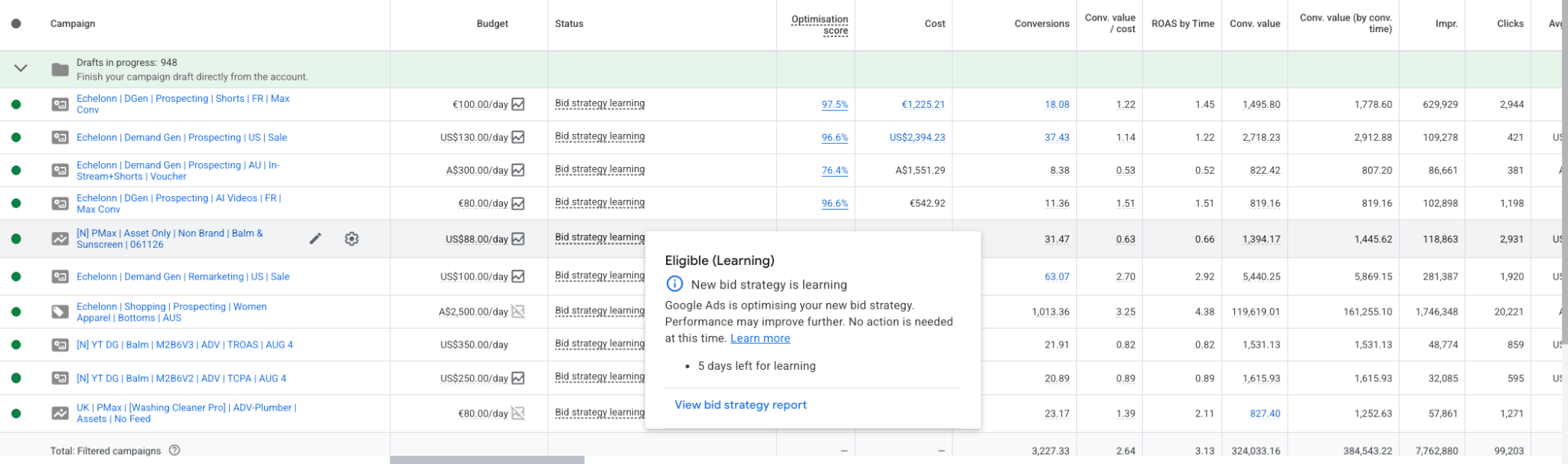
The learning phase is a status Google Ads applies to automated bidding strategies while they adjust to changes in the campaign or bid strategy. You'll typically see it after a new strategy is introduced or certain settings change.
You'll find the status in the Status column of your Campaigns tab, or under Tools > Bid Strategies if you're using a portfolio strategy. Hover over the label and Google will show you why the campaign is in Learning.
During this period, performance can be less stable as the bidding system adjusts to new data and conditions. CPA, ROAS, or conversion volume may fluctuate while the strategy is learning, so short-term performance isn't always a reliable indication of where the campaign will settle.
How Long Does the Learning Phase Last?
Here's the split most explanations skip. Google's own figure for how long calibration can take – up to three weeks, or one to two conversion cycles – is already longer than most summaries of this topic suggest. And even that number is not a promise: Google is explicit that the underlying algorithm keeps learning long after the "Learning" label disappears from the Status column; the label just stops being displayed.
Google ties the length of the learning period to three things: how many conversions your campaigns, ad groups, keywords, or products are generating, how long your typical conversion cycle runs (a same-day purchase behaves very differently from a lead that closes three weeks later), and which bid strategy type you're running.
None of that is measured purely in calendar days. A campaign generating 60 conversions a week will have much more data to work with than one generating eight a month, even if the Status column clears for both within the same few weeks.
This is why we don't put a hard number of days on when a campaign is ready to judge. We use conversion volume instead:
For structural changes specifically (new campaign, new bid strategy, major restructure), we wait a minimum of two weeks and at least 15-30 conversions before drawing conclusions. But some bid strategy setups need well over 100 conversions before they're truly stable.
What Triggers a New Learning Phase?
Google names three specific reasons the “Learning" status appears in the Status column: the bid strategy was newly created or reactivated, a setting on the strategy was changed, or campaigns, ad groups, or keywords were added to or removed from the strategy. In some Shopping campaigns, an ad group target change can also trigger the status.
Worth knowing, because not every change has the same effect: changing your Target CPA or Target ROAS can trigger a new learning period, depending on the bidding strategy and the nature of the change. Google notes that the algorithm may need time to recalibrate towards the new goal after a bid strategy setting is changed.
A sharp jump (doubling your ROAS target overnight, for example) puts the algorithm into unfamiliar territory even without the official label reappearing. The same applies to large, sudden budget increases: the system has to find new auctions to spend the extra money in, which can affect performance while it adjusts.
Our working rule, shaped by exactly this kind of disruption: cap budget increases at 20% at a time, spaced five to seven days apart, unless the campaign is spending under $100/day. Give any bid strategy change at least five to seven days before touching that campaign again.
What Happens During the Google Ads Learning Phase?
We don't get a breakdown of what's happening inside Google's model, and we're wary of anyone who claims they do. What's consistently observable is the pattern: bidding can run broader than usual, performance can swing more than it will later, and that range narrows as more data comes in.
The practical implication is simple. A bad CPA in the first few days of a learning window tells you almost nothing about where the campaign is headed. Swings in ROAS early in the learning window also don't mean much in the grand scheme of things. Reacting to it by pausing, cutting budget, or switching strategy again can make things worse by introducing another change while the strategy is still calibrating.
Performance Max Learning Phase: What's Different?
A standard Search campaign on Target CPA is calibrating within one channel. A Performance Max campaign is optimising across Search, Shopping, Display, YouTube, Discover, Gmail, and Maps within a single bid strategy. That gives the algorithm more types of inventory and signals to work with, which is one reason PMax performance can sometimes take longer to settle than a comparable Search campaign.
There's a specific way this can go wrong that we see often: branded and non-branded traffic sitting inside the same PMax campaign. Because branded searches convert more easily, the algorithm can lean towards them and read that as success. The result is a campaign that looks efficient while doing little real customer acquisition, with the campaign's performance being driven by a very different mix of demand than you might assume.
The same logic applies to genuinely new PMax campaigns with no purchase history behind them: a bidding strategy needs enough conversion data to calibrate before it's asked to hit a specific number. How that plays out depends on how much control you want over the signal early on. The important thing is to give the strategy enough quality conversion data to learn from before judging its performance.
What About Demand Gen Learning?
Demand Gen campaigns can also enter a learning period when using automated bidding strategies. Like Performance Max, Demand Gen uses Google's AI to optimise performance, but advertisers have more control over which channels their ads appear on. Depending on campaign settings, these can include YouTube, Discover, Gmail, and the Google Display Network.
Rather than assuming Demand Gen follows the same learning timeline as Performance Max, monitor conversion volume and performance stability, and avoid making repeated bidding changes while the strategy adjusts.
How to Tell If a Campaign Is Stuck in Learning
A "Learning" label that's been sitting there for weeks, paired with next to no impressions or no spend, may not be a learning problem at all. It can be a different issue with the same status, and often overlaps with other causes.
The four we see most often:
- Budget too small for the target. If your Target CPA or Target ROAS is realistic but your daily budget can't support enough auctions, the campaign may struggle to generate enough volume.
- Target set too aggressively. An unrealistic CPA or ROAS target can restrict bidding because Google can't find enough auctions it expects to meet the target.
- Broken or incomplete conversion tracking. No amount of patience fixes a campaign that isn't receiving a usable conversion signal. This is worth checking before anything else.
- Too little conversion volume. If the campaign isn't generating enough conversions, the algorithm has limited data to learn from, so performance can remain unstable even after the "Learning" label disappears.
If the campaign has enough conversion volume and the basics are clean, give it time rather than reacting to the label alone. If impressions, spend, or conversions remain unusually low, diagnose the underlying constraint instead of assuming the algorithm simply needs longer to learn.
What to Do (and Not Do) During the Google Ads Learning Phase
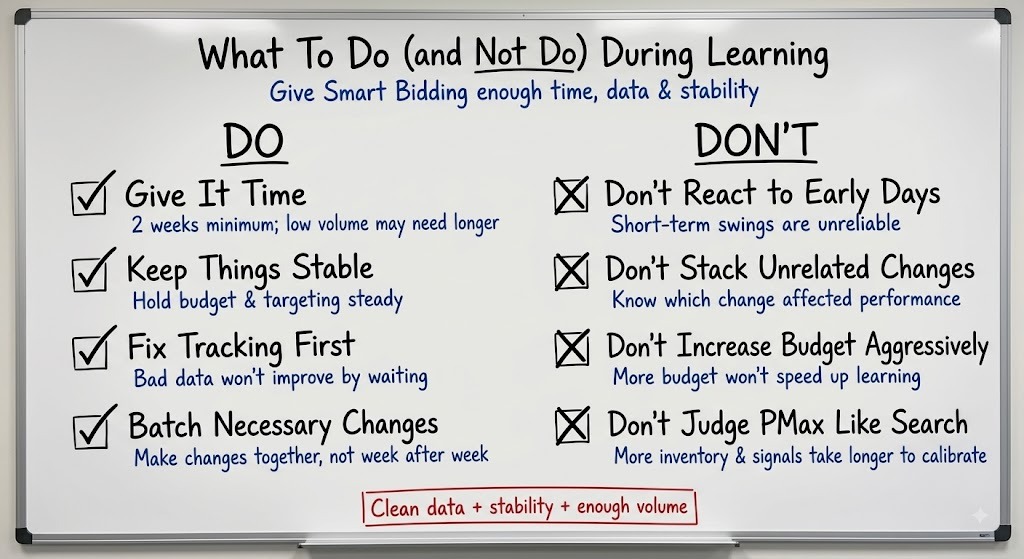
Do
- Give the campaign enough time and conversion volume before judging performance. Two weeks is a useful minimum, but low-volume campaigns may need longer.
- Keep budget and targeting stable while the campaign calibrates.
- Fix tracking issues first. Bad data can't be solved by waiting longer.
- Batch necessary changes together rather than making repeated changes week after week.
Don’t
- Don't react to bad early days.
- Don't stack unrelated changes when you won't be able to tell which one affected performance.
- Don't increase the budget aggressively hoping to speed up learning.
- Don't judge Performance Max by the same timeline as Search. It has more inventory and signals to calibrate across.
The Bottom Line: Let the Algorithm Finish Learning Before You Judge It
The "Learning" label clears well before your data is necessarily trustworthy. Judge campaign performance on conversion volume and actual trends, not on a countdown, and resist the urge to intervene every time performance dips during a period you already know is going to be noisy.
The goal isn't to make the Learning label disappear as quickly as possible. It's to give the campaign enough clean data and stability to make the performance meaningful. Once the signal is there, you can make decisions based on what the campaign is actually telling you, rather than reacting to short-term fluctuations.

Ready To Start Scaling Today?
Scaling Your Favorite eCommerce Brands To The Highest Levels Through Google & YouTube Ads.


Get Smarter About How To Scale Your Brand...
Discover Insider Knowledge On How We Scale Brands From 7 Figures All The Way Up To 8-9 Figures With Google Ads.


"The best Google ads agency there is. You only need to look at the quality of clients and the reviews to understand Jackson and his team are the real deal."

"One of the best in the agency space, great service and exceptional results. Since signing on with Jackson he has become one of our greatest assets when scaling."

"Top tier team & service delivery. Jackson is relentless when it comes to fulfilment & client needs. His attention to detail during the onboarding process ensured exponential results for my coaching business. If you're looking to elevate your ad results & learn a tone of new options/skills that can be implemented to drive more sales to your business then I'd strongly recommend Echelonn."

"From the very first conversation with Jackson and his team, it was clear that we had found a Google Ads agency that prioritises results above all else. Their collaboration between data-driven experts and a skilled copywriter creates a dynamic duo for Google advertising success..."

"Been working with them for 9 months and it's been a great experience. Jackson and his team know what they are doing and always goes above and beyond. If you're looking for a reliable Google ads agency this is the one."

"The best Google ads agency there is. You only need to look at the quality of clients and the reviews to understand Jackson and his team are the real deal."
"One of the best in the agency space, great service and exceptional results. Since signing on with Jackson he has become one of our greatest assets when scaling."
"Top tier team & service delivery. Jackson is relentless when it comes to fulfilment & client needs. His attention to detail during the onboarding process ensured exponential results for my coaching business. If you're looking to elevate your ad results & learn a tone of new options/skills that can be implemented to drive more sales to your business then I'd strongly recommend Echelonn."
"From the very first conversation with Jackson and his team, it was clear that we had found a Google Ads agency that prioritises results above all else. Their collaboration between data-driven experts and a skilled copywriter creates a dynamic duo for Google advertising success..."
"Been working with them for 9 months and it's been a great experience. Jackson and his team know what they are doing and always goes above and beyond. If you're looking for a reliable Google ads agency this is the one."
More Articles Like This.
Find answers to common queries about our services and how we can help you.

Google Ads Learning Phase: What It Means and How Long It Lasts

How to Audit Google Ads Account: The Ultimate Checklist
Performance Max Audience Signals Explained
Google Ads Optimization Score: Should You Trust It?
What Is a Good CTR for Google Ads?
Why More Google Ads Spend Doesn't Always Mean More Revenue
How To Rank Your Google Shopping Ads Multiple Times
Why Your Google Ads Scale Breaks After $X Per Day
How to Tell if Your Google Ads Agency Is Underperforming
Why Your Performance Max Campaign Gets Clicks but No Sales

Why Your Google Ads Budget Isn't Spending (And How to Fix It)

The Right Way to Run Google Dynamic Search Ads
How to Get New Customers With Google Ads in 2026
Why Your Google Ads CPA Keeps Increasing and How to Reduce It
What Is a Good ROAS for eCommerce Businesses?
How to Set Up Google Ads Conversion Tracking the Right Way
How Much Does a Google Ads Agency Cost?
Why Your Google Ads Are Not Converting

Average CPC in Google Ads by Industry (And What It Means for Your Strategy)
Performance Max vs. Shopping Campaigns: Which One is Better?

Why Your Google Shopping Ads Get Impressions But No Clicks (Image Optimization Guide)
Why Your Google Ads Are Not Showing

YouTube Ads Targeting Framework That's Driven $10M+ for eCommerce Brands

What Professional Google Shopping Ads Management Looks Like
How Much Do Google Ads Cost in 2026?

Should Your Business Use Google Search Ads or Performance Max?

Performance Max Best Practices for Sustainable Growth

Google Shopping Ads Audience Targeting: What Actually Impacts Performance

How to Write Google Search Ads That Actually Convert

6 Google Shopping Feed Best Practices That Drive Better ROAS

How to Get Your Products Recommended by AI (ChatGPT, Google AI & More)

Common Google Ads Myths That Cost Businesses Money

7 Benefits of Google Shopping Ads for Your eCommerce Business

How to Switch Google Ads Agency Without Losing Performance or Data

Demand Capture vs Demand Generation: Where Google Ads Fits

How to Prepare Your Business for Working With a Google Ads Agency

How to Avoid Wasting Budget on the Wrong Searches With Google Ads Keyword Match Types
Google Ads Account Ownership: What Businesses Should Know Before Hiring an Agency

Landing Page Optimization Strategies That Increase Conversions
SEO and Google Ads: How Search Engine Optimization and Paid Search Work Together
Types of Remarketing in Google Ads: How Each One Works and When to Use It
Google Ads Keyword Research: How to Find Keywords That Actually Convert

What Is Google Performance Max and How Does It Work?

How Advertorials Support High-Intent Google Ads Funnels

How Audience Targeting Works in Google Search Ads (and When to Use It)

Google Ads for New Brands: What to Know Before Spending Your First Dollar

What Is a PPC Agency – and When It Makes Sense to Hire One

How to Improve Your Google Ads Conversion Rate


The Right Way to Link Shopify and Google Ads for Scalable Growth
Google Shopping Campaigns Setup Guide 2025
Confessions of a Google Ads Auditor: The Worst Mistakes We See Inside eCom Accounts
How to Spy on Competitor Google Ads: Complete 2025 Guide

7 Questions to Ask Before Hiring a Google Ads Consultant
How to Rank #1 on Google Ads: Complete Shopping & Search Guide 2025

Learning Google Ads in 2025: The Roadmap Nobody Talks About

What Makes a Google Ads Specialist Worth $10,000/Month?

Why Cheap Google Ads Consulting Costs You $180,000+ in Lost Revenue

Why 99% of Google Ads Experts Fail (& How to Find One That Won’t)

5 Google Product Feed Fixes for eCom Growth

Google Ads Campaign Structure: Why 95% of Brands Waste Budget on Mixed Traffic

In-House vs Agency Google Ads: Which Delivers Better ROI in 2025?

How to Scale Google Ads With a Small Budget | Setup and Optimization

Google Shopping Optimization: 11 Proven Tactics for Maximum ROAS

eCom Growth Strategy: How We Scaled a Supplement Brand From $1.9M to $8.6M With Google Ads

Google Merchant Center Fix: How to Improve Rankings With Accurate Shipping Times

CTR Is Misunderstood by 95% of the PPC Industry (What to Optimise for Instead)

Google Ads AI | Manual vs Automated Campaign Performance

Complete YouTube Ads Guide 2025 | 3 Formats, 5 Principles, Proven Results

eCom Growth Strategy With Google Ads in 2025

Google Marketing Live 2025: 11 Key Takeaways for Marketers

YouTube Advertising Strategy: How to Drive Results Across Every Format
Google Shopping Feed Optimisation: Tips for Better Results

How Long Does it Take for Google Ads to Work?

Search Ad Strategies to Maximize Sales with Google ads for eCommerce (2024)

2025 Google Shopping Ads: Ultimate Guide, Benchmarks, and Pricing Breakdown

Maximizing ROI with Advanced Google Shopping Bid Strategies and Automated Bidding